Brown Bear Encounters in Lake Clark National Park: Brown Bears of Alaska
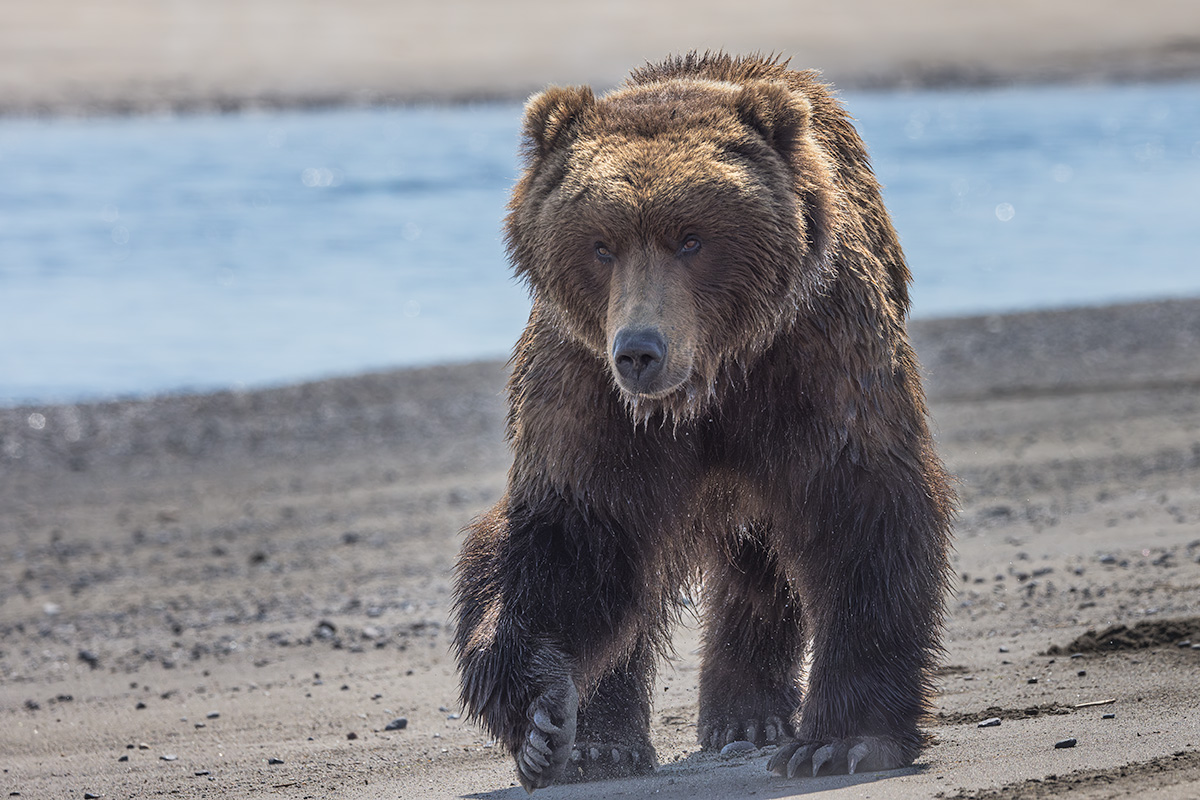
Lake Clark National Park, on Alaska's Cook Inlet coast, holds the highest documented density of brown bears on Earth — 219 individual animals counted in a single 54-square-mile stretch of coastline. Unlike Katmai National Park's Brooks Falls, where bear viewing happens from fixed platforms shared with 300-plus daily visitors, Lake Clark National Park lets small guided groups move with the bears on foot, by boat, or by ATV-trailer along the Bear Coast. Access is by floatplane only — there are no roads. Prime viewing runs early June through late September, with spring cubs, summer salmon runs, and fat bears defining three distinct seasons for serious bear photography and wildlife observation.
Heading to Lake Clark for bears? The free 40-page field guide is yours.
The 219-Bear Phenomenon: The World's Densest Brown Bear Population
That 219-bear count came from a National Park Service survey led by biologist Buck Mangipane and his team across a single coastal section of the park. To put the density in perspective: the study area averaged roughly four brown bears per square mile of productive coastline — a concentration that doesn't occur anywhere else on the continent. It's the statistic that explains why serious wildlife photographers make this park the centerpiece of their Alaska brown bears work.
Buck Mangipane, the park's Natural Resource Program Manager, has tracked the bear population since 2003. His team has documented steady growth of roughly 1.4% per year — a clear signal of a healthy, productive ecosystem that supports the brown bear population. "Given that bears are a big draw for our visitors and also a huge part of the ecosystem, our understanding of their population is really important," he told Smithsonian Magazine. On an average day at peak season, guided groups observe 20 to 30 different bears. Multi-day workshops routinely log 35-plus individual bears across a week of viewing.
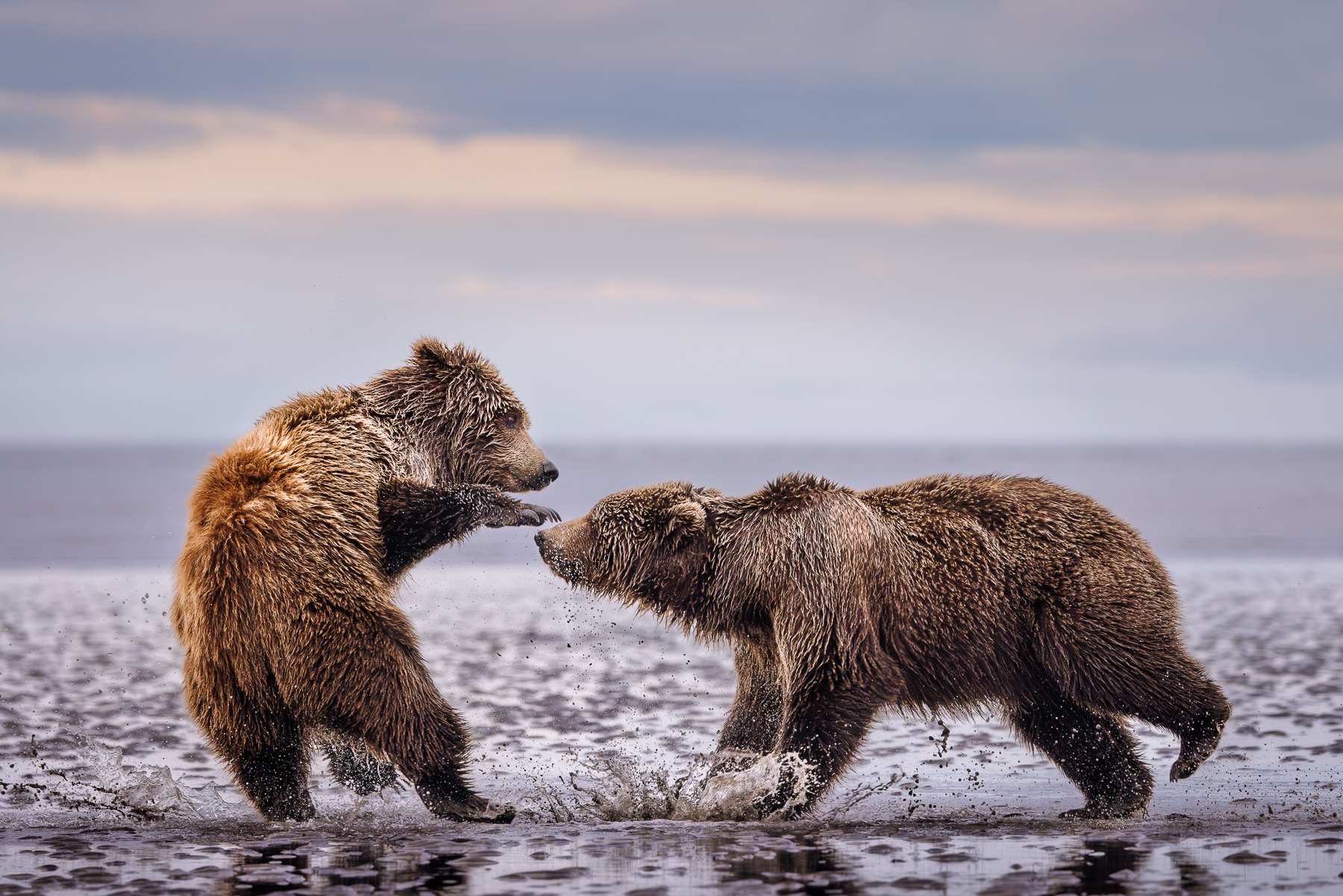
The density comes from the food base. Three overlapping food sources sustain the brown bear population: razor clams along the tidal flats at Chinitna Bay, sedge grass in the salt marshes, and sockeye salmon in the rivers and streams from mid-July through September. Abundant salmon in these drainages is the single biggest factor in the bears' size and density. Few places on Earth stack three calorie-dense food sources on a single stretch of coastline. Brown bears tolerate closer proximity to each other here than in almost any inland habitat because the food pressure is lower — there's enough for everyone, and brown bears congregate along productive streams in numbers that don't occur elsewhere.
This abundance is also why Lake Clark National Park produces such exceptionally large brown bears, and why the natural habitat here ranks among the most productive brown bear habitats in North America. For serious bear viewing photographers, the density translates directly into consistent bear viewing opportunities across every week of the prime season — you're not hoping for brown bears to appear, you're working brown bears from the moment you arrive until the moment you fly out.
Coastal Brown Bears vs Inland Grizzly Bears
Coastal brown bears and inland grizzly bears are the same species — Ursus arctos — but the nutrition gap produces two very different animals.
Alaska brown bears along the Bear Coast commonly reach 600 to 900 pounds by mid-summer. Dominant males exceed 1,000 pounds by September, with the largest individuals topping 1,200 pounds before denning. Their diet is built on salmon, razor clams, and sedge — high-protein, high-fat coastal food sources that pack weight fast. A Lake Clark boar in full September condition is one of the largest terrestrial predators on the continent.
Inland grizzly bears typically top out between 400 and 700 pounds. Despite being the same species, grizzly bears eat berries, roots, insects, carrion, and the occasional moose calf or ground squirrel. The calories-per-hour-of-foraging math doesn't come close to what a coastal bear pulls off the tidal flats in a single low tide.
The behavior difference is as sharp as the size difference. Coastal brown bears tend to tolerate other bears at close range — sometimes within a few meters — because the food pressure is lower. Grizzly bears keep wider territories and actively avoid each other. Understanding bear behavior across these two populations matters for photographers: coastal browns habituate faster to predictable human presence, which is what makes structured bear viewing tours possible at Lake Clark. "Habituate" doesn't mean tame. It means that bears who see well-behaved humans keeping consistent distance simply stop wasting energy on them. Ranges of human bear interactions at Lake Clark are governed by decades of park service protocol and are fundamentally different from the random encounters possible in Denali National Park or elsewhere in inland Alaska.
Black bears also occur in the park but rarely overlap with coastal brown bears in the same viewing areas — browns dominate the food-rich coast, and black bears tend to stay forested inland.
If you've only photographed grizzly bears in Yellowstone or Glacier, coastal browns look like a different animal. They are — in every way that matters except taxonomy.
Seasonal Bear Behavior: Spring, Summer, Fall
Understanding bear behavior by season is the foundation of planning a Lake Clark trip. Each month offers different conditions, different feeding activity, and different photographic opportunities.
Spring: Cubs and Clamming (May–June)
Brown bears emerge from their dens in late April and May, and by early June they're on the coast. This is spring cub season — mothers bring their 4-to-5-month-old cubs down from the den sites for their first real food. Sows with cubs feed heavily on razor clams in the tidal flats at Chinitna Bay and on protein-rich sedge grass in the salt marshes.
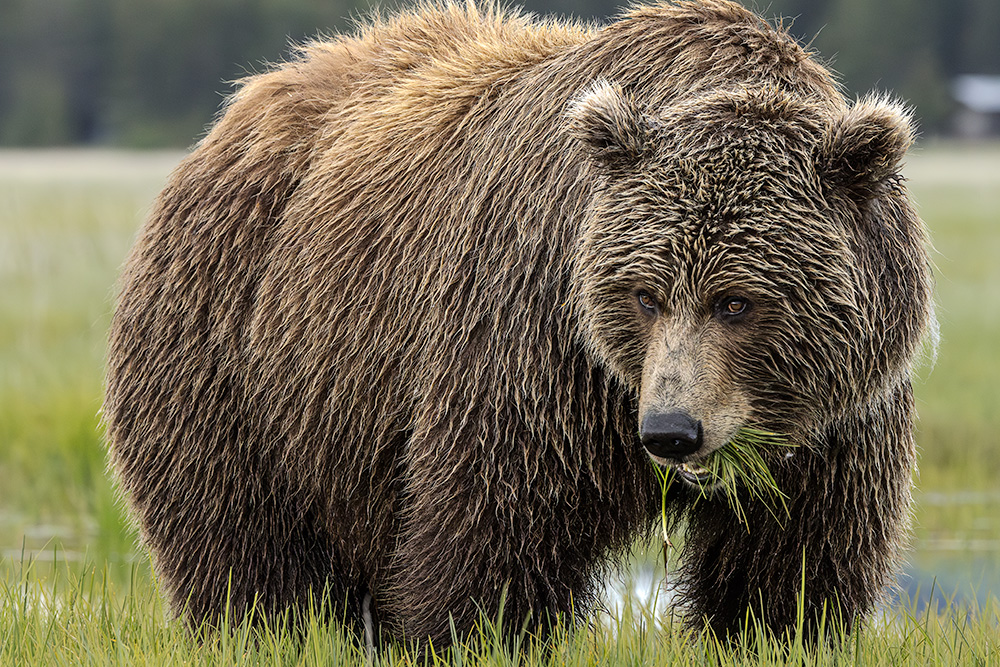
Spring is the season with the lushest green landscapes, fewest visitors, and some of the most photographically rewarding light in Alaska. Cubs are small, coordinated, and curious — they're also learning to dig clams and navigate around other bears. Watching a sow teach her cubs to work a tidal flat at low tide is one of the things you come to Lake Clark for. The green is loud, the bears are working, and the Chigmit Mountains are still capped in snow.
This is the season that feeds my June bear photography workshop — spring cubs, clams, and sedges define that week. For a day-by-day account of a recent June on this coast, read my spring bear photography workshop trip report — six bears the first morning, cubs learning to clam, and one sow, Long Nose, raising two.
Summer: Salmon Runs (July–August)
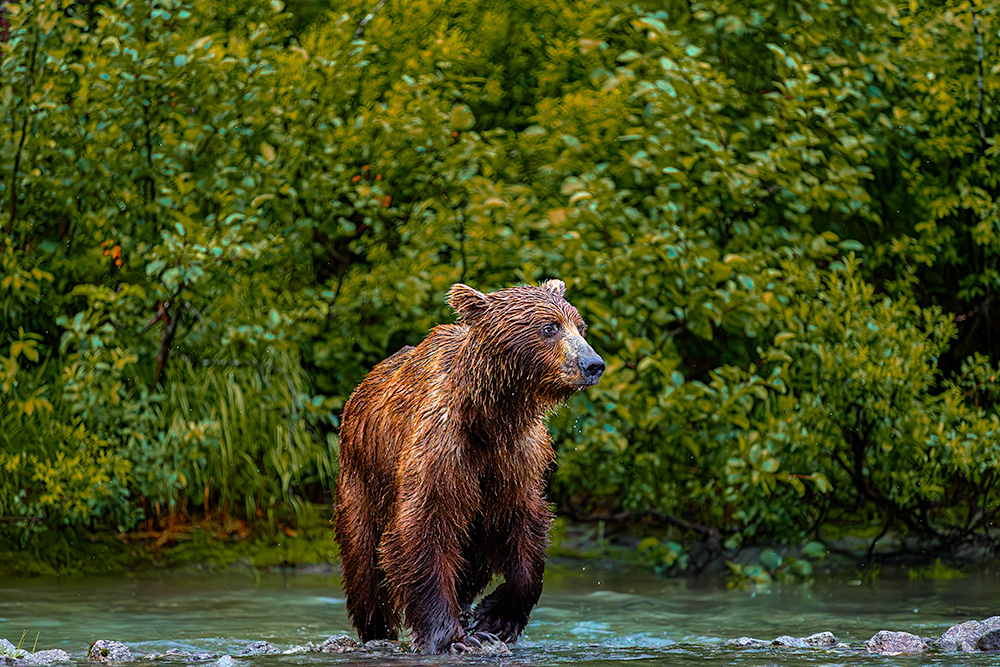
Sockeye salmon start pushing into the rivers and streams in mid-July. By early July the salmon are arriving in numbers, and by the end of July the salmon run peaks. This is when bear activity concentrates hardest on the waterways — Silver Salmon Creek, Crescent Lake, and the tidal streams along the coast. The salmon run is the single biggest driver of bear activity in summer — drawing bears from across the coastal range to productive streams.
Brown bears fish in several distinct ways. Some stand in shallow riffles and grab at fish as they push upstream. Others patrol the shoreline and pin salmon in eddies. Dominant males often steal fish from smaller bears — natural behavior that's easier to witness here than at platform-based viewing sites because you can reposition. On a good July morning at Silver Salmon Creek, you might watch six or eight bears working the same 100-yard stretch of stream.
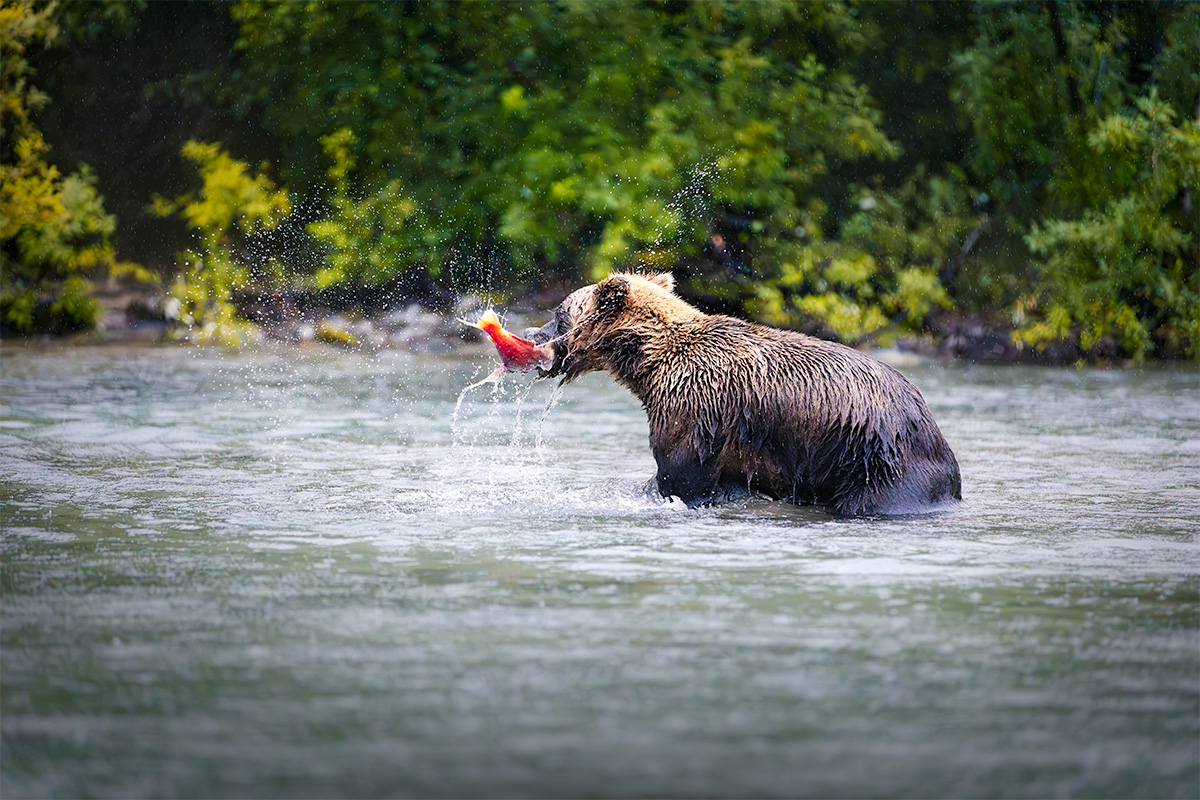
July is the busiest visitor season. Lake Clark is still quieter than Katmai National Park, but flight schedules fill and lodge bookings tighten. If you want July, reserve 9 to 12 months out.
Fall: Hyperphagia and Fat Bears (September)
September is hyperphagia — the extreme pre-denning feeding phase. Brown bears eat up to 20 hours per day. Males that started June at 700 pounds are now 1,000-plus, with thick pre-winter coats and the physical heft that earns them Fat Bear Week attention in mid-October.
The light is different in September. Lower sun angles, golden tundra grasses, fall foliage across the Chigmit Mountains. The air cools, the mosquitoes quit, and crowds thin out after Labor Day. For serious photographers, September is the most technically rewarding month — the combination of light, color, and bear condition doesn't repeat until the following September. That same September light transforms everything across the state, from the Denali corridor to the Brooks Range. My fall Alaska photography trip report captures what that month produces away from the coast.
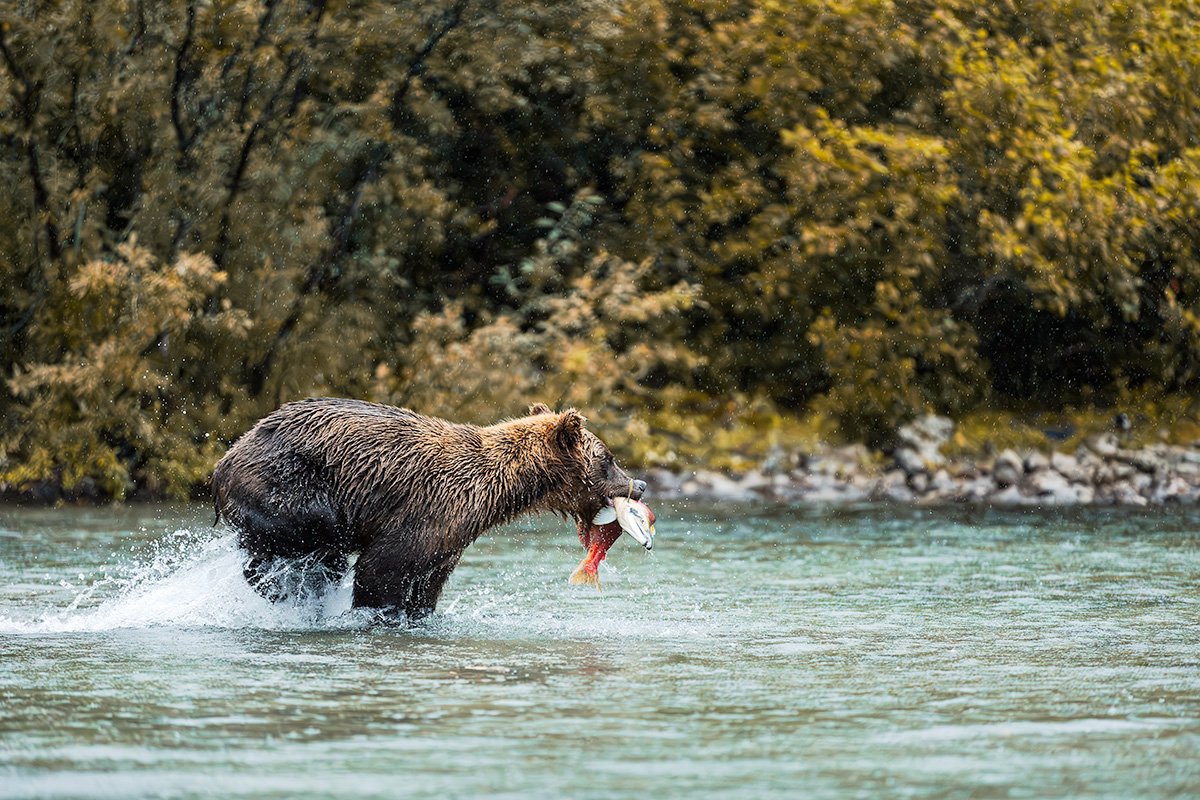
This is the week that feeds my September bear photography workshop — and it's why those seats fill early.
The Bear Coast: Key Viewing Locations in Lake Clark National Park
The Lake Clark National Park coast along Cook Inlet — known as the Bear Coast — is where all serious bear viewing happens. There are three primary locations, each with its own character and access model.
Chinitna Bay
Chinitna Bay sits on the northwest coast of Cook Inlet, inside the park boundary. It's the clam-digging and sedge-grazing heart of the Bear Coast — vast tidal flats, salt marshes, and some of the highest sustained sow-with-cubs numbers in the park. Natural Habitat Adventures operates the Alaska Bear Camp here on a 15-acre private inholding, with a two-story dedicated bear viewing platform and a custom "Bear Mobile" vehicle for broader coastal access. Independent day-tour operators from Homer and Anchorage also fly single-day bear viewing tours into Chinitna Bay during the season.
Silver Salmon Creek
Silver Salmon Creek runs through the northern coastal section of the park. Silver Salmon Creek Lodge has operated here since 1983 and specializes in photography-focused multi-day stays — ATV-trailer viewing, boat access, and ground-based observation of bears in sedge meadows, on tidal flats, and in the creek itself during salmon runs. The lodge accommodates up to 16 guests. This is where I base my bear photography workshops.
Crescent Lake
Crescent Lake sits higher in the Chigmit Mountains, a glacier fed lake colored turquoise by suspended glacial flour. The glacier fed Crescent Lake setting is unlike anything else in the park. Redoubt Mountain Lodge operates here — 10 to 12 guests in rustic private cabins on the shoreline, guided pontoon boat tours for bear viewing, and a dramatic mountain backdrop. The lodge reopened after renovations under current ownership. It offers a quieter, more scenic alternative to the coastal camps, with bears fishing in the lake's clear water against the Chigmit peaks.
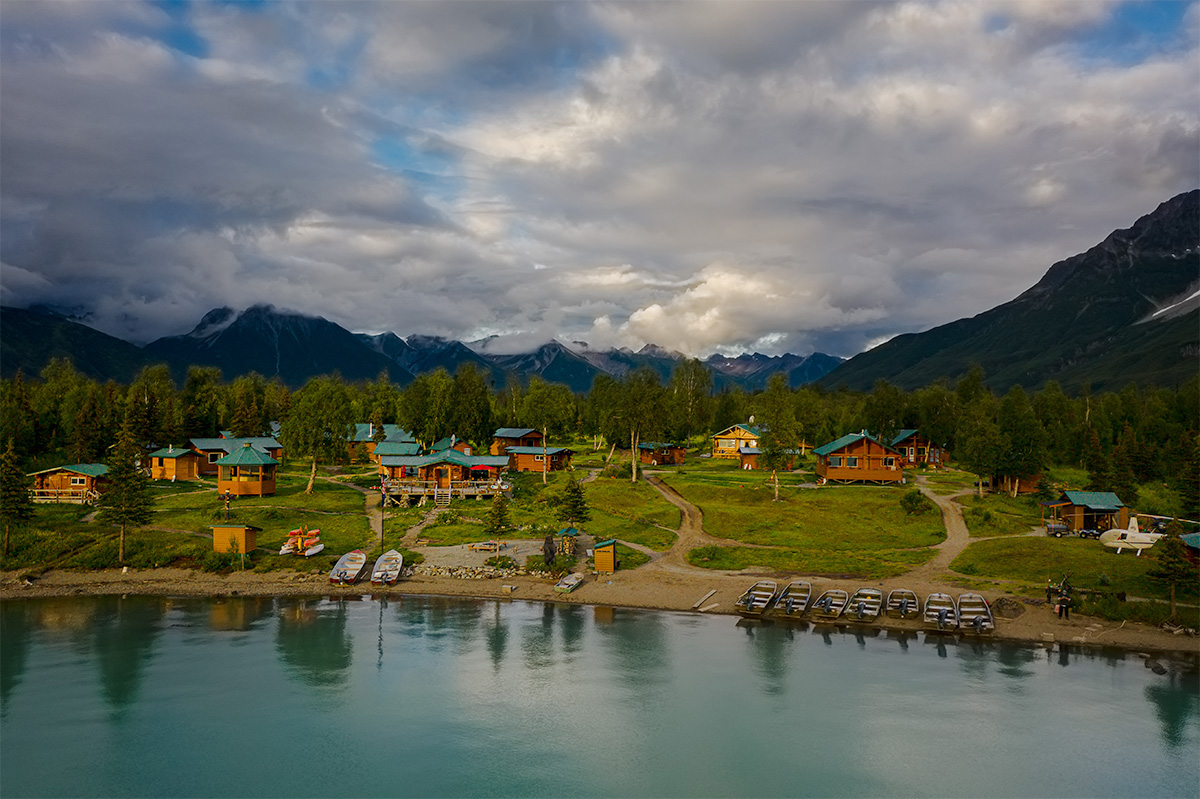
All three locations require floatplane access. None are connected by road to anywhere else. Beyond the named lodges, several independent operators fly single-day trips from Homer and Anchorage to both Silver Salmon Creek and Chinitna Bay. Close encounters with bears — at ethical distances, managed by guides — are the near-certain outcome of any multi-day stay at any of these locations. Bear sightings in the single digits are rare; most guests log 15-plus distinct bears across a 3-to-5-night visit. That consistency is what makes brown bear photography at Lake Clark different from almost anywhere else — the park delivers working bears, not hoped-for sightings.
Wildlife Beyond Bears
The bear viewing areas support abundant wildlife beyond brown bears. Bald eagles soar overhead throughout the coastal areas, often concentrated near salmon runs where they scavenge fish carcasses. Beluga whales frequent Cook Inlet waters and are occasionally visible from coastal viewing sites. For photographers drawn to Alaska's marine wildlife more broadly, my coverage of bubble-net feeding humpback whales in Southeast Alaska shows what the state offers beyond the Bear Coast.
Sea otters, harbor seals, river otters, and various small mammals — ermine, red squirrels, snowshoe hares — move through the forest edge. Moose use the willow thickets at the edge of sedge meadows. This is the kind of natural environment that can't be manufactured: remote wilderness, intact food webs, and wild animals operating on their own terms.
Park rangers conduct regular wildlife surveys across the region, and the data confirms what serious visitors feel on the ground — Lake Clark is among the most productive of Alaska's least-visited national parks, and its abundant wildlife makes it a destination for naturalists, not just bear photographers.
Getting There: Access, Floatplanes, and Logistics
Lake Clark National Park is one of the few U.S. national parks with no road access. The park has no entrance station, no drive-in campground, and no way to reach it without aircraft.
Most visitors fly with Rust's Flying Service out of Lake Hood in Anchorage — about a one-hour flight in a bush plane or floatplane over the Chigmit Mountains and the active volcanoes Mt. Redoubt (10,197 feet) and Mt. Iliamna (10,016 feet). From Homer, the flight is 45 minutes across Cook Inlet. Both options offer spectacular aerial perspectives of country that feels, accurately, uninhabited. Many visitors describe the flight itself as memorable as the bear viewing.
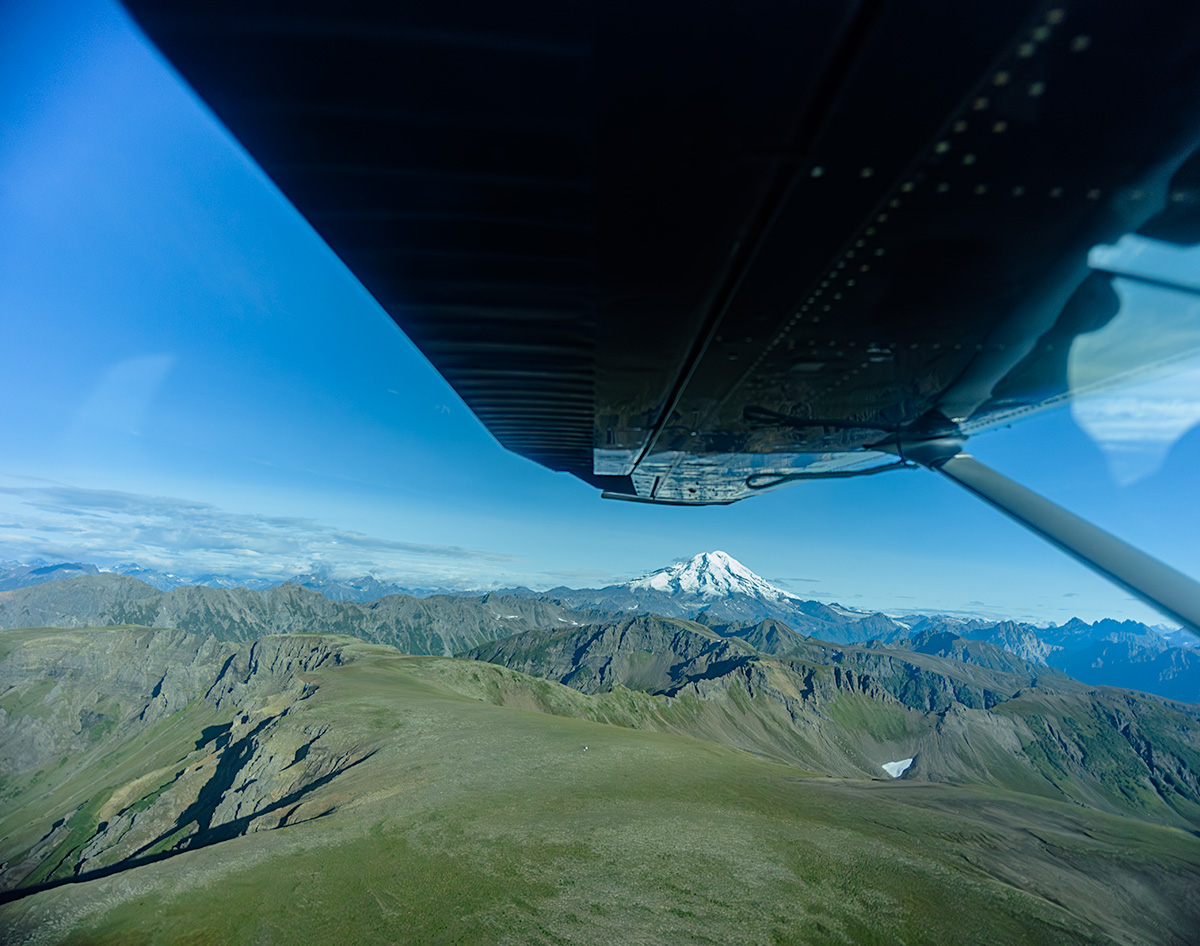
Day trip costs run $440 to $530 per person from Homer and $800 to $1,250 per person from Anchorage. Pricing includes round-trip flight, guided ground time, and a packed lunch, with approximately 3 to 4 hours on the ground. Multi-day lodge stays run $2,000 to $3,500 for 3-4 nights. Premium bear viewing adventure packages and photography workshops run $8,500 for 5-6 nights, all-inclusive.
Weather will cancel flights. Fog, wind, and low clouds can ground floatplanes for hours or days. Never book a connecting flight home on the same day as your bear viewing tour. Travel insurance covering weather-related flight delays is not optional — it's essential. Alaska weather doesn't care about your itinerary.
Katmai vs Lake Clark: The Honest Comparison
This is the question every serious bear photographer asks, so here's the direct answer. Both parks offer world-class bear viewing, but they deliver fundamentally different experiences.
Katmai National Park is famous for one image: a bear with a leaping salmon at Brooks Falls. If that's the specific shot you want, Katmai is the place. During peak July, Katmai's Brooks Falls is spectacular. It's also structured, crowded, and slow.
The viewing happens from fixed elevated platforms. On peak July days Brooks Falls sees 300-plus visitors cycle through — sometimes more than 400. Platform capacity is limited, so during busy periods the National Park Service rotates visitors off the main platform after 30 to 60 minutes. "Bear jams" — where bears park themselves on the trail between the lodge and the platforms — shut down foot traffic until the bear moves, sometimes for 1 to 3 hours. Your viewing angles are whatever the platform gives you. You can't reposition for better light or cleaner composition. Many visitors find Katmai's Brooks Falls visually incredible but logistically frustrating.
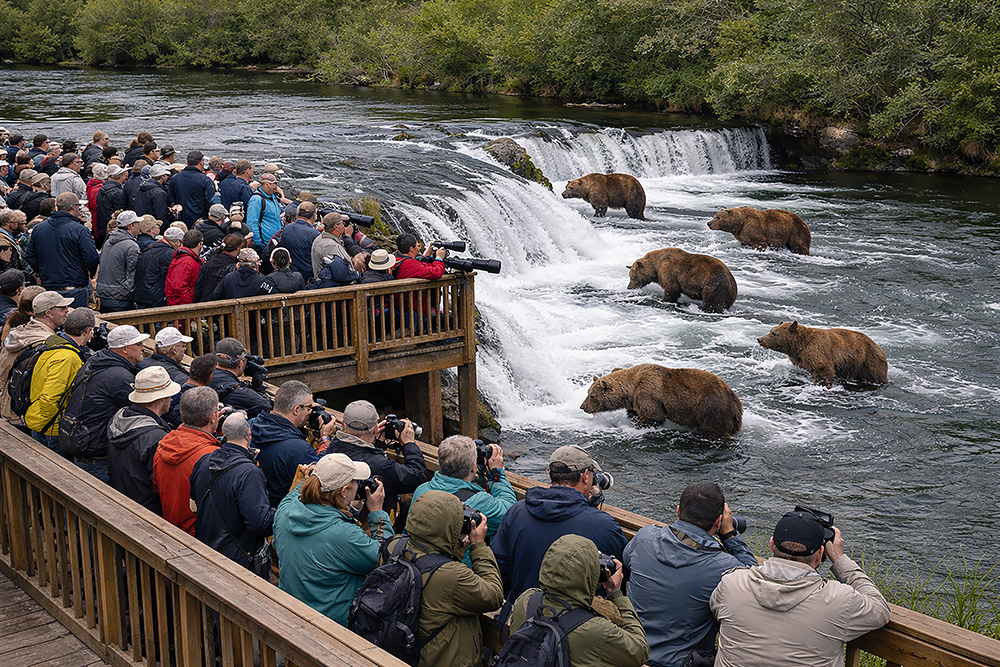
Brooks Lodge overnight stays run $650 to $800 per person per night when available, and July books 6 to 12 months out. Day trips from Anchorage to Katmai National Park cost $900 to $1,200. Flight time is 1.5 to 2 hours each way.
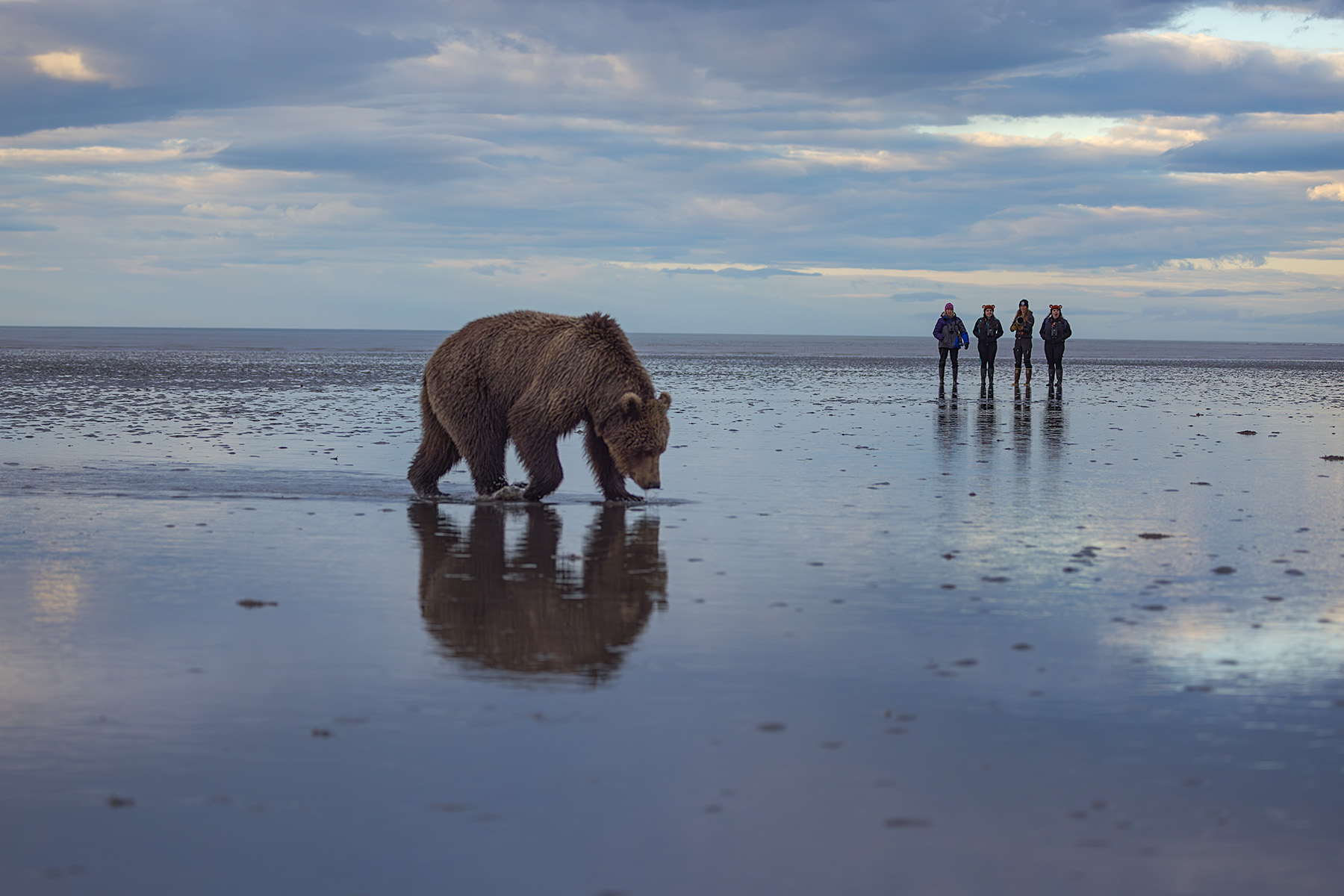
Lake Clark National Park works differently. No platforms, no fixed viewing points, no time rotations. You watch bears from shifting positions — on foot, by boat, by ATV-trailer — at distances set by your guide based on what the bears are doing. Group sizes on my workshops cap at 5 photographers — a deliberate choice. Most Lake Clark operators run 10 to 16 guests per lodge. On a platform at Brooks Falls you're sharing space with 20 or more. At 5 photographers, everyone gets the light angle they want, the position they want, and real-time instruction from me at the bear.
On a typical day at Chinitna Bay, you might photograph bears clamming on the tidal flats at sunrise, shift to sedge meadows for the morning feed, and end at a tidal stream for an evening fishing session. Unlike Katmai, you're working varied settings, varied light, and varied natural behavior across a single day.
The logistics math also favors Lake Clark. Day trip costs run roughly half of Katmai's. Flight time from Anchorage is one hour instead of 1.5 to 2 hours. Advance booking is 3 to 6 months for most dates instead of 6 to 12. Multi-day lodge options cover a wider price range and offer more varied viewing modes — boat, ground, elevated bear viewing platforms, and mobile ATV.
Choose Katmai National Park if: you want the specific Brooks Falls leaping-salmon shot, you're okay with platforms and crowds, you have one day and want guaranteed high-density bear activity, and you're visiting in peak July.
Choose Lake Clark if: you want freedom to work angles and light, you care about photographic variety (clams, cubs, sedges, salmon, reflections, mountain backdrops), you'd rather share a space with four other guests than forty, you want wilderness that feels like wilderness, you're visiting in May-June or September, or you're on a tighter budget — especially departing from Homer.
For most serious wildlife photographers, Lake Clark is the better answer. For the one-day bucket-list bear viewer with Brooks Falls specifically in mind, Katmai may be. Both are extraordinary. They solve different problems.
Safety Protocols and Bear Etiquette
The National Park Service requires a minimum distance of 50 yards (150 feet) from any brown bear, increasing to 100 yards (300 feet) from a sow with cubs or a bear actively feeding. These numbers aren't arbitrary — they're built on decades of encounter data. Bears have a personal space, and violating it triggers defensive bear behavior even in a habituated coastal animal.
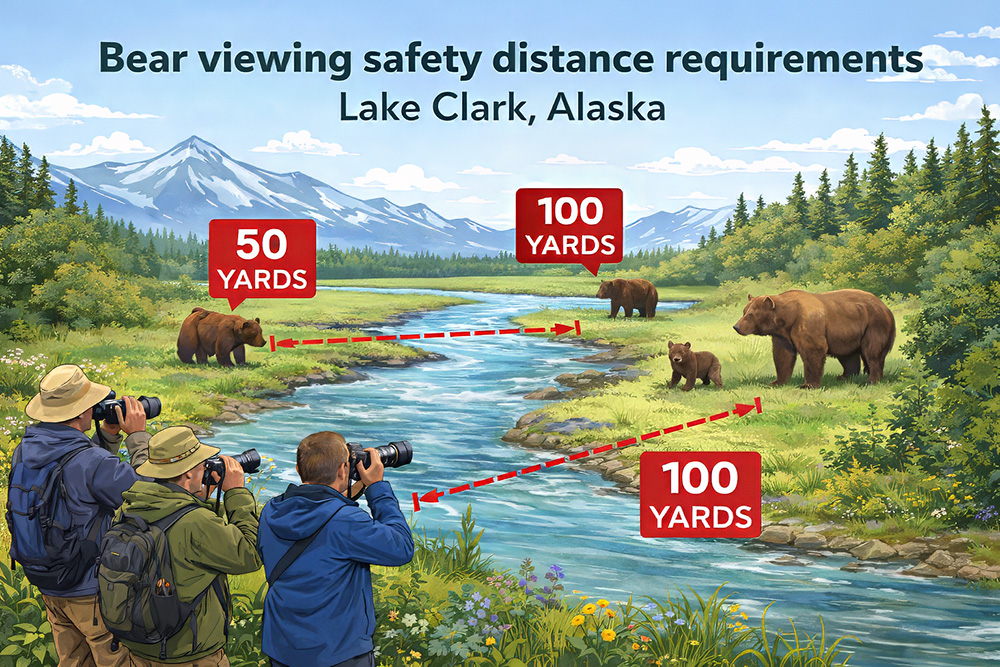
The encounter statistics for guided bear viewing are reassuring. National Park Service records show fewer than 25 bear-inflicted injuries across Alaska's national parks during a 40-year span with roughly 58 million visitors — a rate of about one incident per 2.5 million visits. Guided bear viewing tours are not dangerous when conducted correctly. Park rangers and commercial guides have refined these protocols across multiple generations of visitors. Bear country operates on predictable rules, and when everyone follows them, it works.
Reading Bear Body Language
Understanding bear behavior is the core safety skill. Relaxed bears feed, rest, yawn, and walk with loose shoulders. A bear sitting on its haunches in a sedge meadow grazing peacefully is telling you exactly what it's doing.
Agitation looks different. Watch for:
- Huffing — sharp exhales through the nose
- Jaw-popping — audible clicking of teeth
- A lowered head with ears laid back
- A stiff-legged sideways walk intended to look larger
- Paw-swatting the ground or vegetation
- Direct stare with stillness
Any of these signals means the bear is uncomfortable and needs more space. Your guide will move the group back immediately when these cues appear — often before you've even noticed them.
What to Do During a Bluff Charge
A bluff charge is a warning display where a bear runs toward you and stops short of contact. It's the bear's way of asserting dominance or expressing discomfort with your proximity. Bluff charges almost never end in contact — but they are terrifying in the moment, and how you respond matters.
If a bear bluff charges: don't run (running triggers a chase response), don't turn your back, stand your ground, raise your arms overhead to appear larger, and speak calmly. "Hey bear, I'm leaving" in a low steady voice is the script every Alaska guide uses. Back away sideways once the bear de-escalates. Bear spray stays holstered and accessible — only deployed as last resort if the bear actually makes contact.
During one of my workshops, a sow with three cubs bluff-charged our boat when we drifted closer than she liked. Our guide cut the motor immediately, we all went still, and he spoke calmly to her. She stopped about fifteen feet off the bow, assessed the situation, and returned to her cubs. The whole encounter took fifteen seconds and felt like an hour. Following the guide's instructions precisely was what kept everyone safe.
Food Safety and Leave No Trace
Never drop, leave, or offer food or scented items anywhere bears can access them. A fed bear becomes a dead bear — the saying isn't metaphorical. Coastal viewing camps use Interagency Grizzly Bear Committee (IGBC)-certified bear-resistant containers for all food and scented items. Guides enforce Leave No Trace Principle 3 (Dispose of Waste Properly) without exception. Pack out everything, store food in approved containers, and never eat lunch within 100 yards of an active feeding area.
Larry Aumiller, Alaska's foremost bear biologist and the long-time manager of McNeil River State Game Sanctuary, summed up the philosophy in three words: "Be a neutral part of the environment." That's the whole game — don't subtract from the scene, don't add to it, don't compete with the bear for presence. Stay still, stay calm, stay quiet. The bear is not there for you. You're there to watch bears being bears.
Photography Guide: Gear, Settings, and Golden Hour Light
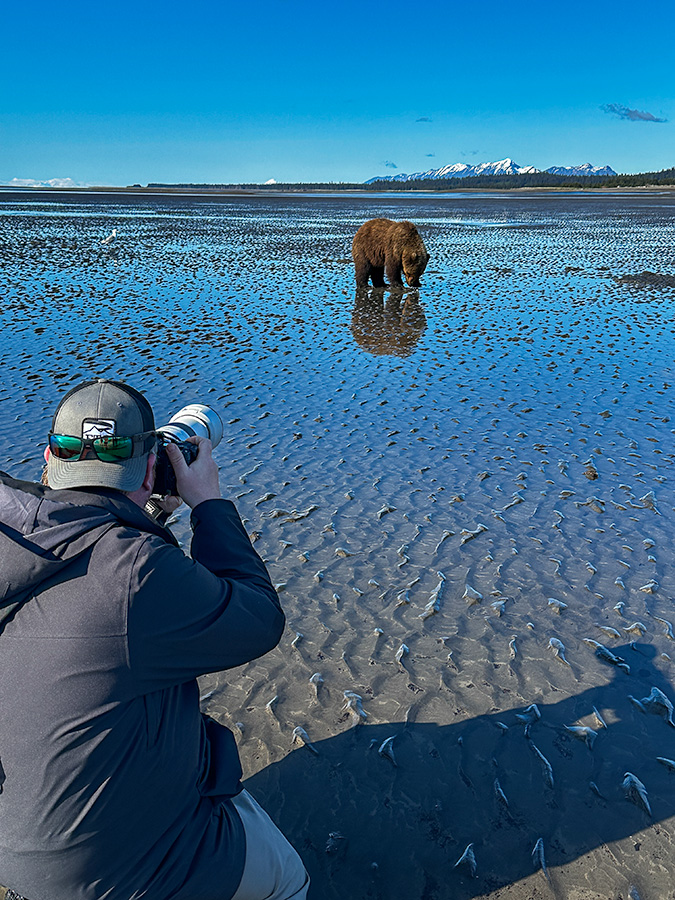
A telephoto lens in the range of 200-400mm is ideal for capturing close-up shots of brown bears without disturbing them, allowing for both detailed portraits — a sow's face, claws digging into a clam bed — and environmental context shots that place the bear in the tidal flat or sedge meadow. Most serious bear viewing workshops pack 100-500mm zooms as the primary tool for brown bears, because the focal range balances bear viewing distance with compositional flexibility. A 70-200mm on a second body gives you wider coverage when bears come closer than long glass can frame. Avoid lenses over 500mm: bears at Lake Clark routinely come close enough that excessive reach becomes a liability, and you'll miss the wider behavioral shots that make this park unique.
The best times for bear photography at Lake Clark are during the golden hours — early morning and late afternoon — when the light is soft and warm. That golden-hour light enhances the natural colors and textures of the bears' coats, the tidal flats, and the surrounding mountain landscape. Bears are also most active during these hours, feeding heavily at first light and again before dusk. Midday light is usable but flatter; the magic hours are where this park produces its best frames.
Shoot in continuous autofocus with back-button focus. For stationary bears in good light, 1/500 to 1/1000 second at f/5.6 gives enough margin for handheld work. To capture dynamic bear behaviors — bears fishing, playing, or interacting with cubs — use continuous shooting mode (also called burst or high-speed drive) at 10 frames per second or higher. Fast action almost always demands ISO above base — knowing how ISO affects image quality keeps your wildlife frames clean even when shutter speed forces your hand.
Continuous shooting mode lets you capture the perfect action shot in a sequence where timing is everything — the split second a salmon breaks the water surface, the exact moment a cub swats its sibling. Focus on the eyes: sharp eyes in a wildlife frame convey emotion and character in ways no other technical choice can replicate. ISO 400 to 800 is the working range in overcast conditions; 1600 to 3200 for pre-sunrise or heavily overcast mornings. If you're still building confidence with these settings under pressure, my exposure triangle for landscape photography breaks down the aperture–shutter–ISO relationship and how to adjust on the fly when light changes fast. For salmon-run action shots — bears exploding out of the water — drop shutter speed to 1/2000 second minimum.
Weather protection is not optional. I've run workshops in rain, fog, wind, and sideways sleet. Your camera body needs a rain cover. Your lens needs a weather skin. If you're coming from a warm climate and want the full gear breakdown for cold, wet field conditions, my essential gear for Arctic photography guide covers everything from battery management to layering systems. Bring two spare batteries in an inside jacket pocket where body heat keeps them warm, and two or three more memory cards than you think you'll need.
The compositional trap is the action shot. Everybody chases the bear-with-salmon frame, which is why that shot has been made a thousand different ways. The quieter work — a sow nursing her cubs in a sedge meadow, a bear digging clams against the reflection of Mt. Iliamna, a mother and cub silhouetted against a glacier lake at blue hour — that's what separates serious bear photography from tourist bear photography. Shoot the action. Then shoot the quieter thing nobody else is shooting.
Ethical wildlife photography starts with not being a problem. Never use flash. Never call to a bear, whistle, or try to get its attention. Never approach — let bears set the distance. If a bear changes behavior because of your presence, you're too close or too loud. Our goal is to photograph natural behavior, which means the bear does what it was going to do anyway. If you want deeper technique support before your trip, my landscape photography for beginners guide covers the settings foundation you'll need in the field.
Planning Your Lake Clark Bear Viewing Trip
The prime window for bear viewing in Lake Clark National Park is early June through late September. Each month offers something different.
June delivers spring cubs, lush green landscapes, minimal crowds, and peaceful sedge-meadow and clam-digging behavior. This is my June workshop month.
July brings the start of salmon runs and the highest bear concentrations at fishing sites. It's also the busiest visitor season. Book 9 to 12 months out.
August offers continued salmon-run activity with slightly thinner crowds than July and bears in solid mid-season condition.
September is hyperphagia — dominant males reaching 1,000-plus pounds, fall color in the tundra, softer low-angle light, and crowds falling off after Labor Day. This is my September workshop month and arguably the most technically rewarding photographic window of the year.
Booking Timeline
Reserve 9 to 12 months in advance for peak July. May, June, August, and September generally still have availability 3 to 6 months out. Photography workshops often sell out a full year ahead for prime dates. Day trips from Anchorage typically have more last-minute availability than Homer-based tours.
What to Pack
Layered clothing, waterproof outer shells, sturdy waterproof boots, bear spray (your guide will provide it if you don't bring your own), binoculars, spare camera batteries, extra memory cards, a camera rain cover, and a dry bag for electronics during boat transport. Temperatures can range from 35°F to 70°F in a single week. Always assume it will rain and be wrong only on the rare perfect day.
Travel Insurance
Buy travel insurance that explicitly covers weather-related flight cancellations. Alaska weather can delay or cancel floatplanes for days in extreme cases. Your trip budget should include at least one extra buffer day on either side of your bear viewing dates.
Conservation: A Success Story Facing New Threats
Lake Clark National Park's brown bear population is a testament to the success of conservation efforts that protect critical habitats and food sources. The 219-bear density in 54 square miles of coastline — one of the highest concentrations of brown bears anywhere on the planet — highlights the health and sustainability of the ecosystem that supports them. Steady population growth of 1.4% annually since 2003 shows that the conservation system is working and the park remains one of the most productive bear habitats in North America.
The park service's commitment to conservation and responsible tourism ensures that these remarkable bear encounters can continue for generations to come, focusing on preserving critical habitats and managing human impact. Park rangers enforce strict viewing distance regulations, limit commercial operator group sizes, and monitor bear populations through annual surveys. Lodge operators holding federal permits must meet specific standards for waste management, group size, and approach protocols. Leave No Trace principles are enforced without exception. These protocols collectively ensure that the park service's commitment translates into measurable protection on the ground.
Despite these protections, the system faces real threats. The proposed Pebble Mine — a large-scale copper and gold mining project in the Bristol Bay watershed just south of the park — represents the most serious current threat to the region's brown bear habitat. The project would affect the headwaters of salmon-producing drainages that feed both Lake Clark National Park's and Katmai National Park's bear populations. Climate change compounds the pressure: shifting salmon run timing, altering tidal flat productivity, and changing the snowpack that regulates watershed flow.
Join Me in the Field
If you want to photograph these bears with a photographer guiding composition, exposure, and bear behavior reading in real time, I run bear photography workshops at Silver Salmon Creek Lodge — maximum 5 photographers, 5 nights, all-inclusive.
- June 2026 — Spring Cubs, Sedges, and Clamming — the spring workshop focused on cub behavior, green landscapes, and tidal-flat work.
- September 11–18, 2026 — Fat Bears, Salmon Runs, and Autumn Light — the fall workshop built around hyperphagia, salmon action, and peak light conditions.
Both workshops include round-trip floatplane transportation from Anchorage, all lodge accommodations, all meals prepared by the lodge chef, daily guided field instruction, and post-processing sessions each evening. Group size caps at 5. Investment: $8,500 per photographer.
View all workshop details and availability →