Sitka Wildlife Photography Trip Report 2026
Seven Days on the Water: Sitka, Kake, and Petersburg
If you're a wildlife photographer weighing a week in Southeast Alaska, this is what seven days produced: seventy-plus humpback whales, bald eagles daily, deer most days, bears on four. Below: the species, the settings, the misses. It matters because the hit rate — not the highlight reel — decides whether the trip is worth your money.
I spent late July 2026 running Sitka to Kake to Petersburg with Neil, my captain for the week, on a 43-foot catamaran. Seven days, three ports, and no plan beyond finding animals and seeing what the country would give up.
Days One and Two — Sitka Sound and St. Lazaria Island
I flew in, checked into the hotel, and met Neil at the harbor. We set out and it wasn't long before we were on whales.
They weren't surface-feeding — they were working, coming up to breathe and then going back down. Several times we had humpbacks on either side of the boat at once, close enough that you heard them before you saw them. That's the sound nobody tells you about. The blow is the signal, not the fin. Then the back arches, and you have about two seconds to be ready for the fluke going up as the animal dives deep to feed again. Day one was a fluke-and-blow day, and if you're expecting lunges on your first afternoon out here, adjust.
It started cloudy with light rain. By afternoon that broke to sunshine and gave us real light to work with.
We ran out to St. Lazaria Island, the seabird colony off Sitka Sound, where tufted puffins, common murres, cormorants, gulls, bald eagles, and black oystercatchers were all working the same rock.

We finished the afternoon exploring the water around Sitka at a sea otter nursery. Sea otters here live in the kelp forests and calm bays, and the females wrap themselves and their pups in the kelp and simply sit in the protected water — one of the few subjects out there that holds still long enough to compose properly.

Neil dropped a hydrophone and we listened to the whales talking underneath us.
Mount Edgecumbe was out in full force, and when the cloud moved across the volcano the landscape became the better subject for a while. Worth saying plainly: a wildlife trip in this country is also a landscape trip, and the light doesn't ask which lens you brought.
Eight to ten whales on the first afternoon.
Day two we found bears. A sow with three cubs of the year was fishing chum salmon out of the ocean at low tide on one side of a cove, with two more bears working the far side. The cubs were the show — one would steal a fish its mother had finished with and bolt off to keep it from its siblings. It was obvious what the attraction was. Schools of chum were jumping everywhere and swimming around the boat, a Steller sea lion turned up to take its share, and the animals were all there for one reason — these coves are feeding grounds for a few weeks a year.

Bald eagles were the soundtrack, and bald eagles are frequently seen in Sitka right through the summer months — immature and mature birds in the trees and on the bank, their calls filling the whole cove. The immature ones were testing new feathers with the kind of flying that keeps your finger down.
Then we went looking for whales. More scattered than the day before — roughly eight.
Six bears and eight whales, and I slept at the Sitka Hotel. It's an older building but a good one, walking distance to the harbor where Neil picked us up and to the restaurants in town.
Day Three — The Run to Kake
We left at seven and pulled into Kake around half past four.
The transit was the surprise. Twenty-five to thirty humpbacks on the way, plus Dall's porpoises, brown bears, and black bears along the shore. Sitka black-tailed deer were on the beach the whole way — we counted around a dozen working exposed kelp at low tide, which is the single most reliable way to find them here. They come down for it, they stay put while they eat, and the light off the water behind them does the rest.

One whale was tail-slapping when we spotted it from a distance and had stopped by the time we closed. Another breached a couple of times and did the same thing. That happens more than the highlight reels suggest — you see the behavior, you commit, and it's over before you arrive.
We pulled into a cove with a working hatchery and found somewhere between ten and fifteen brown bears on the salmon returning to it. There was a clear dominant boar. Then a sow brought a cub of the year out of the trees to fish, which was a surprise twice over — it added to everything already happening, and it's not what you expect from a sow with that many bears around. The boar made an advance toward them and she took the cub straight out, working the shoreline for food instead. That's the real dynamic at a concentrated food source, and it's the frame most people don't come home with.
More whales before we reached town — another dozen at least, and a few porpoises.
After we settled in we went to a creek near the village stacked with chum, gulls, eagles, and black bears — about fifteen of them, up and down the water. A sow with two cubs joined, and the cubs went high into a tree and fell asleep while she fished below.

The day closed with the sun breaking under the overcast and going gold and pink across the bay, with the eagles and gulls covering the beach at low tide.
Day Four — Bubble-Net Feeding, Fifty-One Times
I went back to the creek before breakfast. I could hear the cubs from the day before crying to be fed, and the creek was full of eagles and bears again. This time the sow brought both cubs down to the shore a couple of times before she caught a fish and took it high up the bank to feed them.
After breakfast we went looking for the bubble-net group. We were spotting blows not long after leaving the dock, but we weren't after one or two animals — we wanted the cooperative group of seven or more.
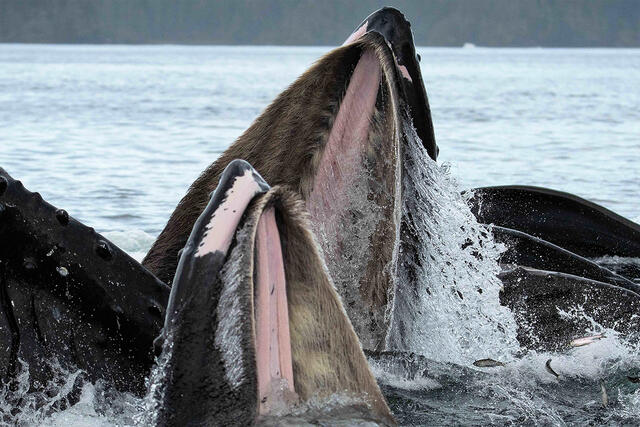
It took about an hour. We found fourteen to sixteen humpback whales going to town on herring, and we counted every time they came up. They surfaced fifty-one times. The fifty-one — the last feed before we turned for home — came up off the bow at about fifteen feet.

The hydrophone is what made the afternoon. You could hear them calling to each other as they orchestrated it, and there's a distinct sound that goes out when it's the call to rise. Knowing it's coming doesn't tell you where — that part was genuinely hard to pin down. What worked was the gulls. They honed in on the spot before the whales broke the surface, so we stopped watching the water and started watching the birds.
One whale made a sound like a fog horn, loud enough to echo a long way off the landscape.
Snow-covered peaks behind them when the position worked out. A few breaches on top of everything else.
Over fifty whales for the trip at that point.
We stayed at the Waterfront Lodge, owned and run by Patty, a local. She cooks the meals and packs the lunches, and it's homestyle — which means she isn't set up for dietary restrictions. Supplies are limited in Kake and bringing them in isn't cheap, so you eat what's dished up and it's all good. There are no restaurant options in the village. There's a grocery store if you're particular, but plan on the lodge.
Day Five — A Full Day on Land
Low visibility kept us off the water, which is the part of a trip report people leave out.
We took the logging roads instead. Twelve Sitka black-tailed deer, a cow moose with a calf, a sow black bear with two cubs, and bald eagles — which is true of every day of this trip, on the water and off it. Eagles are the one species in Southeast Alaska you stop counting. The Tongass National Forest in that weather is its own subject — deep green, heavy moss, creeks running, and rain sitting in beads on spruce needles. If you only bring long glass to Southeast Alaska you will spend days like this with nothing to do.

We went back to the creek in the evening and got a sow with twin cubs, another sow with a single cub that was entirely focused on eating whatever she caught, and two boars that decided they wanted the same fishing spot. They went at each other in the rain with neither backing down until one broke and was chased into the brush.

Days Six and Seven — Petersburg and LeConte Glacier
We set out for Petersburg through Frederick Sound and checked islands known to hold Steller sea lions on the way. The haul-outs were empty — we got a deer and harbor seals on the rocks near the surf instead. We did see Steller sea lions in the water along that stretch, just never piled on the rocks where you can work them properly. That's the difference between seeing an animal and photographing it, and it's worth understanding before you come: a haul-out gives you a stationary subject and a composition. A sea lion surfacing beside a moving boat gives you a wet head and about two seconds.
Later, out in Frederick Sound, we found the bubble-net group again and spent more time with them before continuing on. Frederick Sound near Petersburg is renowned for this — active pods feeding in calm, protected water — and it earned the reputation while we were in it.
Then LeConte Glacier, which is why the last stretch matters. The whole fjord reminded me of Norway, which is apt — Petersburg is called Little Norway. Icebergs throughout, and the mountain faces still carry the texture from where the glacier scoured them in previous years. More breaching whales off in the distance. Over sixty for the trip.

Bald eagles again, as on every other day of the trip. Patience is essential here for capturing optimal wildlife behavior — the hour we spent searching for the bubble-net group, and the islands that turned up empty, are the same job as the minutes when everything happens.
We stayed at the Scandia House — close to the restaurants and the harbor, good rooms, and they run a shuttle.
The final day we went out to a group of islands known to hold a lot of harbor seals, and they were waiting for us along the rocky shorelines. Then we searched a known spot where the sea otters congregate with their pups in the seaweed beds. They weren't on the beds — they were rafted in a group just off them. Still worked.

A few more whales on the way in. Final count: more than seventy humpback whales in seven days.
What a Full Day on the Water Actually Looks Like
A working day here runs long. In late July you have light from before five in the morning until close to ten at night, and the boat is out for most of it. Expect eight hours or more underway on a good day, with the middle of it spent looking rather than shooting.
That's the honest rhythm of it: long stretches of transit and searching, punctuated by ten or fifteen minutes where everything happens at once. The searching is not wasted time — it's how you find a bubble-net group instead of hoping one turns up.

Boat size decides the rest. Small photography groups enhance wildlife viewing experiences in Sitka, and a vessel in this class carries about six photographers comfortably. That number is not arbitrary — six people can all get to a rail without stacking. On a large excursion boat you're shooting over shoulders and down at the water instead of across it, and the angle is the whole difference between a snapshot and a photograph.
What We Photographed
This is a trip that combines marine and terrestrial wildlife in the same day, which is unusual and is the main argument for the region. You can photograph whales in the morning and bears in the evening without changing towns. Nearly all of it is behavior rather than portraiture — feeding, fishing, fighting, fledging.
Marine mammals: humpback whales, sea otters and pups, Steller sea lions, harbor seals, Dall's porpoises.
Bears: coastal brown bears and black bears, including multiple sows with cubs of the year, on four of seven days.
Birds: bald eagles every single day of the trip, mature and immature, on the water and inland — tufted puffins, common murres, cormorants, gulls, black oystercatchers.
Land mammals: Sitka black-tailed deer can be photographed in Sitka and right through the region — we had them on most days of the trip, on the shoreline, on the logging roads, and on the water crossings. Moose cow and calf on the land day.
Landscape: Mount Edgecumbe, LeConte Glacier and the icebergs in the fjord, glacially scoured rock faces, Tongass rainforest, low-tide shoreline.
What we did not get: Steller sea lions hauled out on the rocks — we saw them in the water but never got them stationary — and a full day on the water on day five.
Landscape Between the Wildlife
Nobody comes here for the landscape and most people leave with it anyway.
Mount Edgecumbe anchors the view out of Sitka Sound, and the peaks above the water take late light well — the long evenings in June and July are what make that possible. Sitka and the country around it offer breathtaking sunsets: the light runs gold first, then goes pink through the underside of the cloud, and at this latitude in July the whole thing stretches long enough to work a scene properly rather than grab one frame and lose it.

Our best evening was at Kake. The sun broke under a heavy overcast and lit the whole bay, the tide was out, and the beach was covered in eagles and gulls. One adult sat on a root wad on the flats with the light coming off the water behind it — gold across the mud, pink in the cloud, and a mountain wall going soft in the haze behind that.

Around Petersburg, Frederick Sound and the icebergs off LeConte are a different subject entirely, closer to Norway than to anything else in Alaska. And the Tongass National Forest is the constant: mossy, wet, dense, and best photographed in exactly the weather that keeps you off the water.
Mountains, coastline, and the water between them are the three elements in almost every frame here. That combination is why photographers keep coming back to this stretch of coast even when the wildlife doesn't cooperate.
May through July is the stretch most people target here for landscape, and it overlaps cleanly with the wildlife season. Carry something wide. You will want it.
Gear and Settings From a Moving Deck
Wildlife photography in Sitka emphasizes behavioral shots rather than static portraits, and that single fact drives every setting below. Almost nothing I brought home from this week is an animal standing still. It's a sow pulling a chum out of the surf, a cub bolting off with a stolen fish, two boars going at each other in the rain, sixteen whales coming up through their own bubble net, an immature eagle figuring out its wings. Behavior is fast, it's unrepeatable, and it does not wait for you to change a dial.
The platform is the second problem. You are handholding on a boat moving in two axes while your subject moves in three, and the reciprocal rule you learned on land does not apply. Shutter speed is doing the work of a tripod.
Shutter speed. Stay at 1/1000 or faster for anything on or above the water — breaches, lunges, flukes, birds in flight. Faster if there's chop.

Lenses. Bring range rather than one number. Federal rules keep you 100 yards off humpback whales, and at that distance a whale fills a fair amount of frame on a long lens — but the animals also surface close enough that you'll be backing off. Most people run a telephoto zoom somewhere in the 100–500 range plus a wide-to-mid zoom on a second body. Anyone who gives you one focal length hasn't shot from a boat.
Autofocus. Continuous, with animal tracking if your body has it, and continuous shooting mode. The bubble-net rise gives you no time to acquire.
Weather-sealed gear. Rain, mist, and salt spray, sometimes in the same hour. Sealed bodies and lenses if you have them, rain covers if you don't, microfiber cloths you can actually reach, and a plan for drying everything at night. A polarizer earns its place cutting glare off the water.
Read the birds. On the bubble-net feeds the gulls were a more reliable indicator of where the whales would surface than anything we could see or hear.
Seasons: What Changes and When
May and early spring is when brown bears come down to the coastlines and beaches to graze sedge before the fish arrive. It's an open, exposed way to photograph them, and it's a different look than the salmon-stream work.
June and July are the widest window for variety. The days are long, the whales are in, the seabird colonies are active, the eagles are everywhere, and the first salmon are moving.
August through October is when the salmon run peaks and pulls brown bears onto the streams in numbers. We were early on that curve in late July and still found bears on four days.
A note on the bears regardless of month: every bear I photographed on this trip was reached by boat with a captain who knows the water, or on foot with a guide. Wandering a salmon stream on your own looking for bears is how people get hurt and how bears get displaced off a food source they need. Organized, guided access is not a sales pitch here — it's the only version of this that works for the photographer and the animal.
March and April is a different trip. Humpback whales are often seen bubble-net feeding in spring, and the behavior I watched in July intensifies during the herring spawn, when prey concentration climbs and the cooperative feeding gets more frequent and closer to shore. Steller sea lions and bald eagles are abundant in spring too, in on the same food. Neil has run that window for years and it's what the spring trip is built around. The dates move with water temperature and tides, so nobody publishes a fixed calendar for it and you shouldn't trust anyone who does.
If you want to understand the behavior itself before deciding which window suits you, I've written a longer piece on how humpback whales bubble-net feed and how to photograph it.
Access, Ethics, and Where I Won't Send You
I've named towns, named waters, and named a public wildlife refuge in this report — Sitka Sound, St. Lazaria, Kake, Frederick Sound, Petersburg, LeConte. I haven't named the specific coves, creeks, or haul-outs, and I'm not going to.
The distinction matters. A refuge with a seabird colony is public information and the birds are not displaced by a boat holding off it. A working salmon stream with fifteen bears on it is a different case, and traffic changes behavior at exactly the places where the animals can least afford it. The spots that matter are a captain's knowledge, built over years. That isn't mine to publish.
Federal marine mammal rules require 100 yards off humpback whales, and approach is the boat's call, not the photographer's. If a whale closes that distance on its own, that's a different situation than motoring in — and the difference is the entire ethical question.
At the creeks, the bears have right of way and the fish have right of way. If your presence changes what an animal was doing, you're too close.
If drones come up: they're a tool for water and scale, subject to local restrictions, and they are not a wildlife technique here. Don't fly them at marine mammals.
Frequently Asked Questions
Will I see humpback whales in Sitka? In seven days across Sitka, Kake, and Petersburg I counted more than seventy. Whales are the most reliable subject in this region during summer. Bubble-net feeding specifically is a different question — that took an hour of searching on the day we found it, and it isn't guaranteed on any given day in any season.
What's the best month for wildlife photography in Sitka? It depends what you want. June and July give you the widest species spread and the longest light. August into October concentrates on bears as the salmon run peaks. Spring concentrates on whales and the herring spawn. None is better; they're different trips.
Is Sitka or Juneau better for photography? Sitka Sound gives you protected water, St. Lazaria, sea otter nurseries, and volcano backdrops within a short run of the harbor. Juneau carries far more cruise traffic. For photography specifically, less traffic wins.
What time of day are humpbacks most active? We had feeding activity through the middle of the day, which is not what most landscape shooters expect. The light is the constraint, not the animals. Early and late gave us the best conditions; midday gave us the most action.
How many days do you need in Sitka for wildlife photography? Two full days out of Sitka gave a good sample. Seven gave a genuine cross-section including a weather day, and the weather day is the argument for length. Under three days and you're gambling on conditions.
What's Next
I'm building two trips out of this — a spring bubble-net workshop and a late-season multi-species trip, both small groups, both boat-based in this same country.