
Caddo Lake Photography Workshop: Texas Cypress Swamps — November 2027

CADDO LAKE, TEXAS

Peak November in the Cypress Swamps

November 6–9, 10–13, or 14–17, 2027. Five photographers max per session. Cypress swamps, pre-dawn mist, peak fall color, four full days on Caddo Lake.

NOVEMBER 2027 · THREE SESSIONS

$2,800per photographer
SessionsNov 6–9, 10–13, 14–17
Group5 max
Deposit$500
Final payment90 days prior
Reserve Your Spot — $500 Deposit

Questions? Schedule a call with Michael


WORKSHOP OVERVIEW

About the Caddo Lake Workshop

The Caddo Lake Photography Workshop is a four-day landscape and wildlife photography workshop on Caddo Lake, Texas, built for photographers of every skill level — from people still learning manual exposure to advanced shooters chasing a portfolio frame — who want to photograph the cypress swamps during the one short window the lake's signature scene comes together. It matters because that window is narrow: peak fall color and reliable pre-dawn fog overlap for only about twelve days in early November, and shooting it well takes both access to the right water at the right hour and instruction in how to expose for fog, color, and reflection. This workshop gives you both.

Caddo Lake sits on the Texas-Louisiana border and is the only natural lake in Texas — often called the largest flooded cypress forest in the world, and one of the largest in North America. In early November the bald cypress needles turn rust, orange, and bronze, and cold nights over warmer water produce the pre-dawn mist the place is known for. The workshop is built around that specific window — sunrise and sunset sessions from stable kayaks in the backwaters and cypress sloughs, one sunrise on a pontoon with a local captain for the main body of the lake, and evening Lightroom and Photoshop sessions.

Small group of five photographers, personalized instruction, no lodging or meals bundled in — which is why this photo tour is $2,800 instead of $4,000+. You capture Caddo Lake with good instruction and keep your own style of travel.

DATES

Nov 6–9, 10–13, or 14–17, 2027

Three sessions to choose from

TUITION

$2,800 per photographer

$500 deposit · Final payment 90 days prior

GROUP SIZE

5 photographers max

Per session

LOCATION

Caddo Lake

Uncertain, Texas · Texas-Louisiana border

SKILL LEVEL

All levels welcome

Beginners through advanced

ALUMNI RATE

Ask for yours

Returning FTOP workshop participants

RESERVE YOUR SPOT — $500 DEPOSIT

Questions? Schedule a call with Michael

WHY THREE SESSIONS

Why Three Sessions in November

The three sessions are identical in structure — same itinerary, same locations, same instruction. Pick the week that fits your schedule.

SESSION 1

November 6–9, 2027

Color coming in with more green in the canopy

Last quarter moon

SESSION 2 · PEAK

November 10–13, 2027

Usually peak color

New moon

SESSION 3

November 14–17, 2027

Tail end with dramatic light on bare branches as color drops

First quarter moon

First session (November 6–9) tends to catch the color coming in with more green in the canopy. Second session (November 10–13) is usually peak. Third session (November 14–17) runs the tail end with dramatic light on the bare branches as the color drops. None of those are guarantees — Caddo Lake does what it wants — but that's the general pattern from prior scouting at this lake and a decade of participant reports from other photographers who shoot this lake every November.

Like most Caddo Lake workshops, this one focuses on capturing the unique beauty of the cypress swamps during peak fall colors in November — the only twelve-day window worth shooting the lake's signature scene.


EIGHT SUBJECTS · FOUR DAYS

What You'll Photograph at Caddo Lake

Caddo Lake is not a pretty lake. It is a labyrinth of bayous and sloughs and shallow water where towering bald cypress trees rise out of tea-colored blackwater. Spanish moss hangs from nearly every branch. Great Blue Herons work the edges. The light through the fog at sunrise does something you cannot replicate anywhere else in the country. This is what four days gets you.
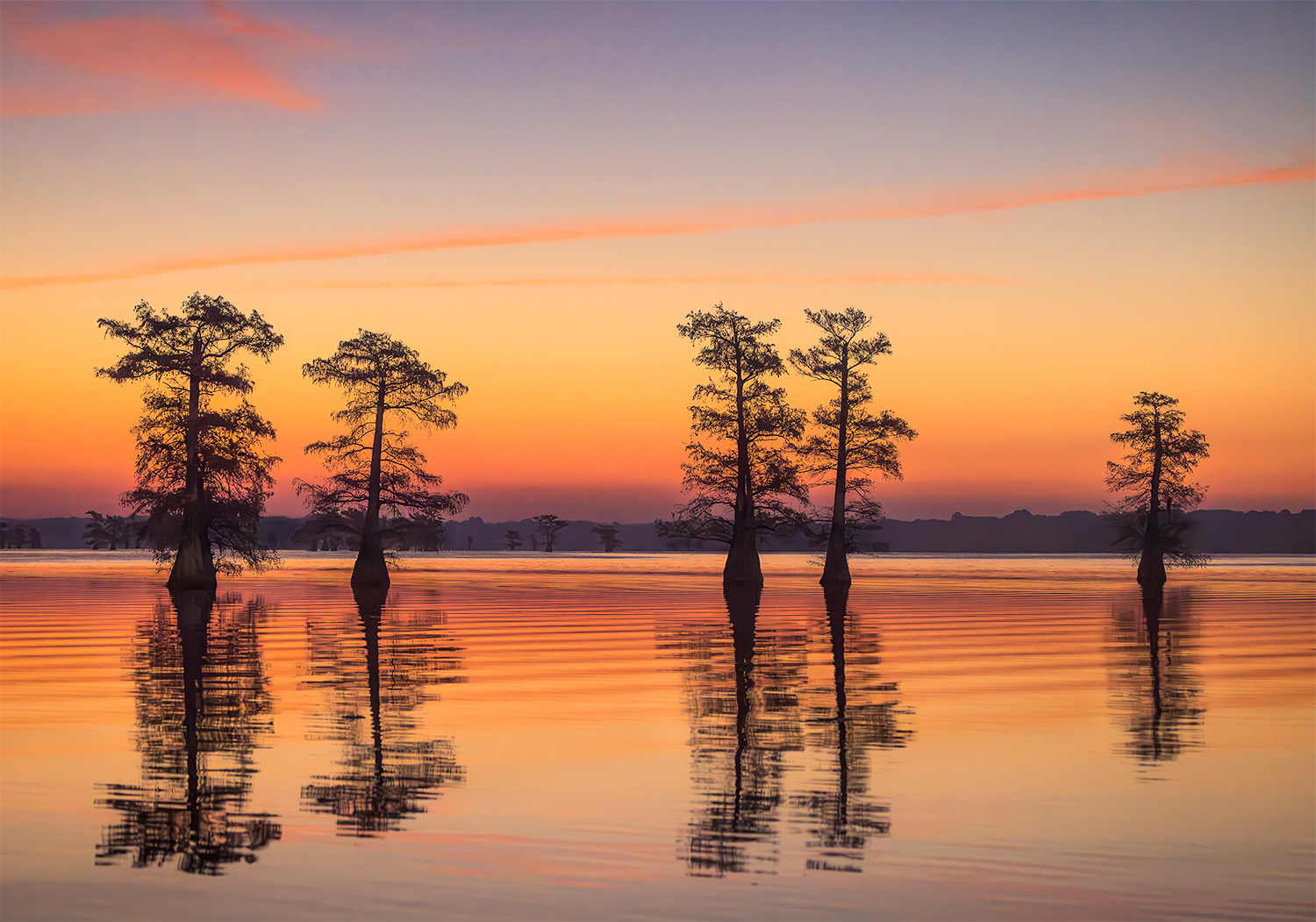
Sunrise silhouettes cypress trees at Caddo Lake Texas during photography workshop golden hour session

01

Pre-Dawn Mist

Towering cypress trees emerging from atmosphere, silhouettes layered into the distance, dramatic light cutting through as the sun breaks the horizon. The defining photo at Caddo Lake.

02

Rust and Gold Bald Cypress Trees

Unlike northern forests, bald cypress needles turn warm bronze, rust, and orange tones in November. Against dark water and silver Spanish moss, the color sits in a specific range that rewards careful white balance and subtle editing.

03

Big Cypress Bayou

The scenic waterway connecting Caddo Lake to Jefferson, Texas — roughly a three-hour drive from New Orleans through piney woods country. Moss-draped, narrow in places, wide in others. Different compositions than the main lake, and worth the paddle for the best images.

04

Backlit Spanish Moss

Moss glowing at sunrise when the light comes through from behind. Best shot with a longer focal length and deliberate exposure for the highlights.

05

Mirror Reflections

Calm morning water doubles the scene. Ancient trees mirrored perfectly until the first boat wake breaks them. Get there before anyone else.

06

Wildlife in the Frame

Great Blue Herons, Great Egrets, pileated woodpeckers, wood ducks, and the occasional river otter. A long lens in the kayak next to your wide-angle gets you both kinds of frames without switching boats.

07

Sunset on the Water

The moment most competitors underplay. Most Caddo Lake operators run sunset from a mud boat on the open lake; we use a stable pontoon with a local captain for proper tripod footing. Late afternoon light rakes across the cypress groves and isolated trees silhouetted against the dropping sun.

08

Intimate Details

Cypress knees breaking the waterline, root systems below, lichen patterns on bark, curves of moss. Not everything here is a grand vista. Slow down and you find compositions nobody else shoots.

Alligators are mostly dormant by November. Beavers and otters stay active. The lake is yours and four other photographers.


SHOOTING WINDOWS

Best Times to Photograph Caddo Lake

Caddo Lake is photogenic year-round, but autumn is the season that brings photographers from across the country. Here's what each time of year delivers, and why the three sessions are scheduled when they are.

Spring vs Fall at Caddo Lake

Spring · March–May

Greenest and Busiest

Spring photography at Caddo Lake captures vibrant greens and active wildlife — new cypress growth, nesting herons and egrets, alligators waking from winter, and the remarkable biodiversity of the bayou on full display. It rewards a different kind of nature photography than autumn — greener, more wildlife-driven, with its own unique landscapes. What it does not produce is the lake's signature scene: the needles are green rather than rust, and the reliable pre-dawn fog hasn't arrived. There is no spring workshop session.

Fall · Early November · The Workshop Window

The Signature Scene

Fall at Caddo Lake — specifically early November — is when the signature scene comes together. The bald cypress needles turn rust, orange, and bronze, and cold nights over warmer water produce the heaviest, most reliable pre-dawn fog of the year. That overlap of peak fall color and atmospheric fog is the reason all three workshop sessions are scheduled across the twelve-day November window, and it is the only time of year the lake delivers the rust-and-fog cypress photograph this workshop is built around.

Best Times of Day for Caddo Lake Photography

Sunrise is particularly special for photography at Caddo Lake, as the cool night air meeting the warmer water creates thick layers of mist and fog, enhancing the atmospheric conditions for capturing images. The golden hours surrounding sunrise and sunset are crucial for capturing magical light at Caddo Lake.

PRE-DAWN TO 8 AM

The signature window. Fog is thickest, water is still, light is soft, and the lake is empty. This sunrise session is when the iconic Caddo Lake images are made.

MID-MORNING · 8–10 AM

Fog lifts, warm light rakes through the cypress, backlit Spanish moss glows. Different compositions than pre-dawn — intimate details over wide scenes.

LATE AFTERNOON TO SUNSET

Underrated by most photographers. Sunset light across the main lake hits isolated cypress with dramatic warm tones. Cleaner compositions because the fog burns off.

BLUE HOUR · POST-SUNSET

Rarely shot because most photographers are packing up. Cypress silhouettes against cobalt sky are worth staying for, 30 minutes after sunset.
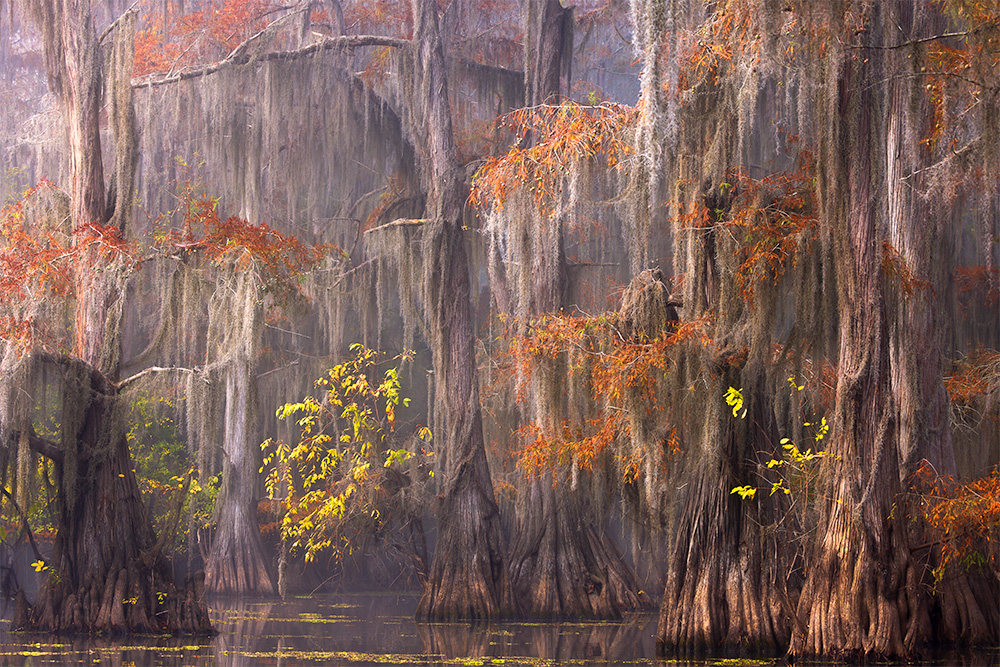
Morning golden glow illuminates fog weaving through Caddo Lake cypress trees during Texas photography workshop

FALL COLOR

Best Months for Fall Color Photography

The best time to photograph Caddo Lake is during the fall, specifically from late October through November, when the bald cypress needles turn vibrant shades of rust, orange, and bronze. Peak color typically runs November 5 through November 18. Bald cypress is unusual among trees because it is deciduous — the needles turn before falling. That color window is short and weather-dependent. A cold snap in late October can push peak earlier. A warm fall can delay it past mid-November. The three workshop sessions are scheduled across this twelve-day window specifically to catch the highest-probability peak conditions.

WEATHER

Weather Conditions and Atmospheric Light

Fog forms at Caddo Lake when overnight air temperatures drop at least 15°F below the water temperature. In autumn that differential happens most nights. Clear, cold nights produce the heaviest mist. Warm, humid nights produce less. Rain or overcast days have their own beauty — soft diffused light on the cypress and Spanish moss produces a different kind of photo entirely. There are no bad conditions at Caddo Lake, only different ones worth capturing.

MOON PHASE

Moon Phase Considerations

A waning or new moon is ideal for pre-dawn fog work — darker sky means more dynamic range in the twilight transition, and no moonlight washing out the fog. The November 2027 sessions are scheduled around this. Session 1 (November 6–9) falls near last quarter moon, Session 2 (November 10–13) is near new moon, Session 3 (November 14–17) is first quarter. All three fall in favorable moon windows. None coincide with a full moon.

FOUR-DAY RHYTHM

Daily Rhythm — What the Workshop Looks Like

Four days, kayak-based with one sunrise from the pontoon for main-lake work. Stable wide-bottom recreational boats specifically chosen for photography are the primary platform. Participants in this Caddo Lake workshop can expect to explore the area using small boats or kayaks, allowing access to hidden locations in the bayou backwaters and cypress sloughs — and the unique perspectives for photography that most boat-tour photographers never reach. One pre-dawn during the workshop we take the pontoon out on big Caddo Lake with a local captain for sunrise from a stable tripod setup. Nobody is on your schedule but yours — if you want to keep shooting when everyone else breaks, you can.
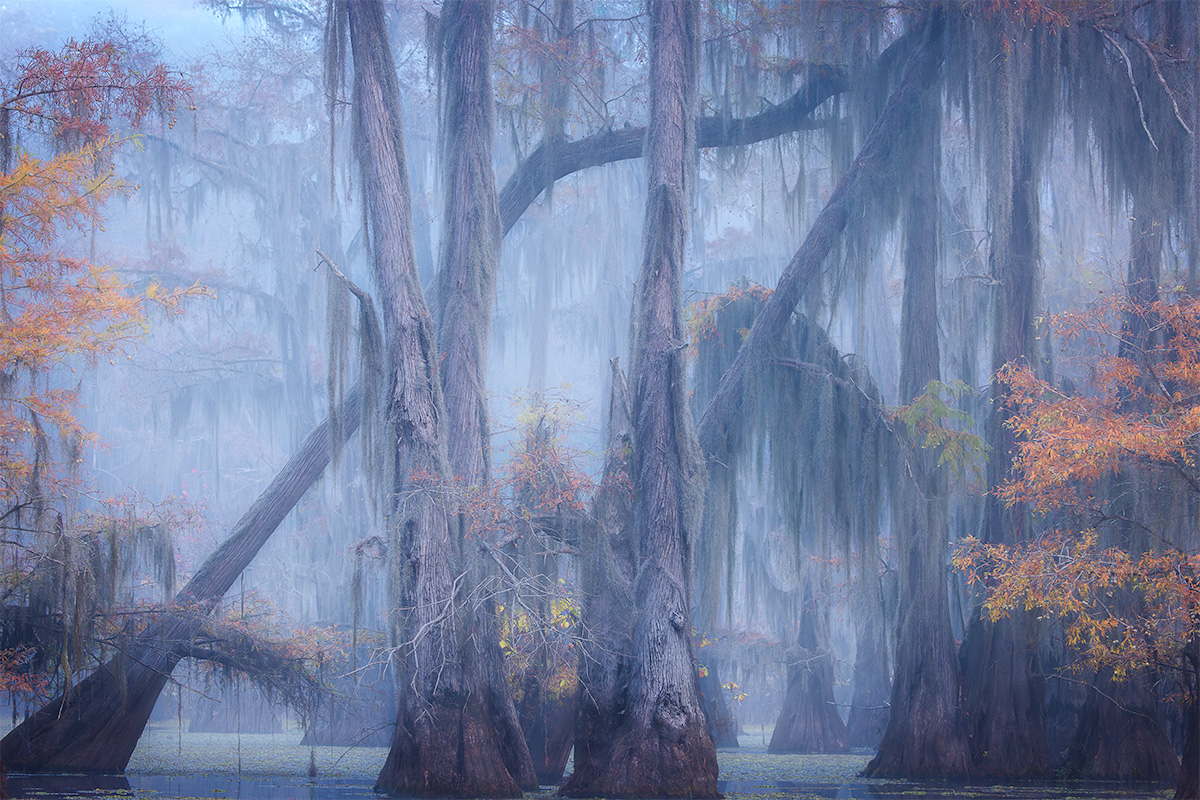
Foggy cypress swamp at Caddo Lake — primary kayak shooting environment

DAY 1

Arrival and First Shoot

Meet at the launch point mid-afternoon for introductions, gear check, and kayak assignments. We cover the lake map, the week's weather outlook, and what to expect from the kayak sessions. Then we head out for a short sunset shoot to get everyone comfortable with the kayaks and dialed into shooting from water before the early light wake-up on Day 2.

DAYS 2 AND 3 · MORNINGS

Pre-Dawn on the Water

Pre-dawn meet at the launch, kayaks on the water before first light. This is the signature window — heaviest mist, stillest water, no boat traffic, softest light. We work the cypress groves and sloughs for two to three hours as the sun comes up.

One morning during the workshop is the pontoon boat day — we cross open water to the main lake with the local captain, set up tripods on the pontoon, and shoot sunrise across Caddo Lake's big body from a stable platform. The scale and the compositions are different out there: isolated cypress against open water, long sightlines, fog working differently than in the sloughs.

DAYS 2 AND 3 · AFTERNOONS

Image Review and Golden Hour

Back to shore for late breakfast and an early lunch image review. Midday is the longest classroom block: composition breakdown of the early photos, camera settings for cypress color and atmospheric haze, Lightroom and dodge-and-burn techniques for directing attention. Late afternoon back on the water for golden hour and sunset, aiming for different compositions in different backwaters. Evening Lightroom session at a restaurant or local cabin depending on the group.

DAY 4

Final Sunrise, Group Critique, Depart

One more pre-dawn session on the water. By now you know the lake, you know your gear in these conditions, and you know what you want to shoot. This is usually when people make their strongest image of the week. Back to shore by mid-morning, final group critique of everyone's best frames from the four days, then the workshop concludes by early afternoon.

WHAT YOU'LL LEARN

Skills You'll Develop

Workshops at Caddo Lake often include hands-on instruction in photography techniques, focusing on composition, light management, and post-processing. This one is no different — except for the small group size, the personalized feedback, and the four full days. Most centered on working in low light, handling atmospheric conditions, and reading reflections. Instruction happens in the field and in evenings in front of screens, tailored to your skill level.

METHOD 01

In the Field

Working with atmospheric light. Fog and mist change your exposure math. They eat contrast, compress tones, and reward specific compositional choices. You'll learn how to meter for these conditions, when to shoot into the atmosphere vs. through it, and how to use it for depth.
Pre-dawn and blue-hour exposure. Shooting before sunrise from a stable kayak means long exposures, low ISO, and careful focus in low light. We cover tripod technique on water, focusing in the dark, and when to push ISO vs. extend shutter speed.
Composition in complex environments. Caddo Lake is visually busy — cypress trunks, moss, branches, reflections. We work on leading lines through the groves, using reflections to double compositions, finding the single tree that anchors the frame.
Shooting from water. Kayaks shift under you. Tripods don't work on a paddle boat. You'll develop a handheld approach on a mirrorless camera or DSLR that still produces sharp photos at slower shutter speeds, and learn when the larger boat's stable platform is worth waiting for.
Filter work. When the circular polarizer earns its place vs. when it gets in the way. Graduated ND for sunrise gradients, long-exposure ND for the pontoon morning on the main lake.

METHOD 02

Post-Processing Instruction

Lightroom workflow for fog and low contrast. Fog compresses tonal range. We cover how to restore depth without crushing the mood — tone curve work, dehaze without overdoing it, selective clarity.
Cypress color in November. The rust, bronze, and orange of bald cypress needles sit in a narrow color range. Heavy-handed saturation kills it. We cover subtle HSL work and white balance calibration that keeps the color honest.
Dodge and burn for directing attention. Luminosity-based selective adjustments to pull the viewer's eye where you want it to go — without the heavy-handed look that gives it away.
Black and white for cypress forms. Some Caddo frames want monochrome. We cover when to make the call, how to convert for maximum tonal separation, and how to keep Spanish moss texture intact.

METHOD 03

Wildlife Photography at Caddo Lake

Caddo Lake is home to a diverse range of wildlife, including alligators in warmer months, turtles, and various bird species — Great Blue Herons, Great Egrets, wood ducks, pileated woodpeckers, and occasional bald eagles. A long lens ready alongside your wide-angle means you don't have to choose between landscape and wildlife when a Great Blue Heron lifts off six feet from your kayak. To capture compelling images, photographers should use a long telephoto lens and approach wildlife quietly to avoid startling them. Ethical wildlife photography at Caddo Lake requires respecting natural behavior: no baiting, no approaching nests, no actions that disturb or stress the animals. A 400mm or longer lens and a quiet approach produces the strongest compositions. During the November workshop, alligators are mostly dormant — birds and mammals are the primary wildlife encounters.

METHOD 04

Intentional Camera Movement and Abstract Reflections

Caddo Lake does not always hand you the clean rust-and-fog frame. When the light goes flat or harsh and there's no obvious composition in front of you, that's the moment to work the water itself. Intentional camera movement — dragging the camera through a slow exposure — turns the fall-color reflections on the surface into abstract patterns of rust, gold, and bronze. The shimmer of color moving on tea-colored water becomes the subject. I shoot this at Caddo every trip when conditions stall, and it's one of the techniques most photographers skip because they're locked into hunting the same wide cypress shot. We cover the shutter speeds, the movement direction, and how to read which reflections will hold up as abstracts. It's the difference between packing up on a dead-light morning and coming home with frames nobody else on the lake made.


INVESTMENT & DETAILS

Workshop Investment and What's Included

The primary goal is getting you to the best photography location with enough time to actually capture the images. Lodging and meals are deliberately not bundled in — you arrange your own accommodations and meals, which keeps your total trip cost flexible.

Pricing

Tuition

$2,800 per photographer

Deposit

$500 non-refundable, secures your spot at registration

Final Payment

Due 90 days before workshop start date

Alumni Rate

Available to returning FTOP workshop participants, applied at final payment

Dates

Nov 6–9, 10–13, or 14–17, 2027 (three sessions)

Group Size

Maximum 5 photographers per session

✓ Included

  • Four days of instruction — in-field guidance and evening classroom sessions, led by Michael Schultz
  • All watercraft — kayak rental for the backwaters and sloughs, plus one pontoon boat sunrise on the main lake with a local captain
  • Park and launch fees — all Caddo Lake State Park entrance fees and boat launch fees covered
  • Evening Lightroom and Photoshop sessions — hands-on editing instruction on your own images
  • Portfolio review — one-on-one critique and feedback during the workshop
  • Pre-workshop gear list and location guide — emailed to registered participants 60 days before arrival
  • Small group size — maximum 5 photographers per session

✗ Not Included

  • Lodging — accommodations in Uncertain, Texas or the surrounding area are your responsibility
  • Meals — all breakfasts, lunches, dinners, and snacks are on you. Several local restaurants in Uncertain and nearby towns are worth eating at
  • Travel — airfare, ground transportation, and standard rental car costs are not covered. You need your own transportation to and from the launch point each day
  • Camera gear — bring your own
  • Travel insurance — strongly recommended but not included

Recommendations for lodging, restaurants, and a full equipment list are all included in pre-workshop materials.

Reserve Your Session

Three sessions. Five photographers max. Peak November cypress.

$2,800 per photographer · $500 deposit secures your spot · Final payment due 90 days before workshop start

Alumni rate available for returning FTOP workshop participants

RESERVE YOUR SPOT — $500 DEPOSIT

Questions? Schedule a call with Michael

PACK LIST

What to Bring

A detailed equipment list is emailed to registered participants 60 days before the workshop. The summary below is enough to start planning what to pack and what to buy before November.

01

Camera Gear
Weather-sealed camera body. DSLR or mirrorless. November humidity and kayak spray mean weather sealing matters. Bring the camera you already know well.
Wide-angle lens. 16-35mm f/2.8 or equivalent for grand cypress scenes and reflections from the kayak.
Mid-range zoom. 24-70mm or 24-105mm. Probably your most-used lens for intimate scenes and isolated cypress compositions.
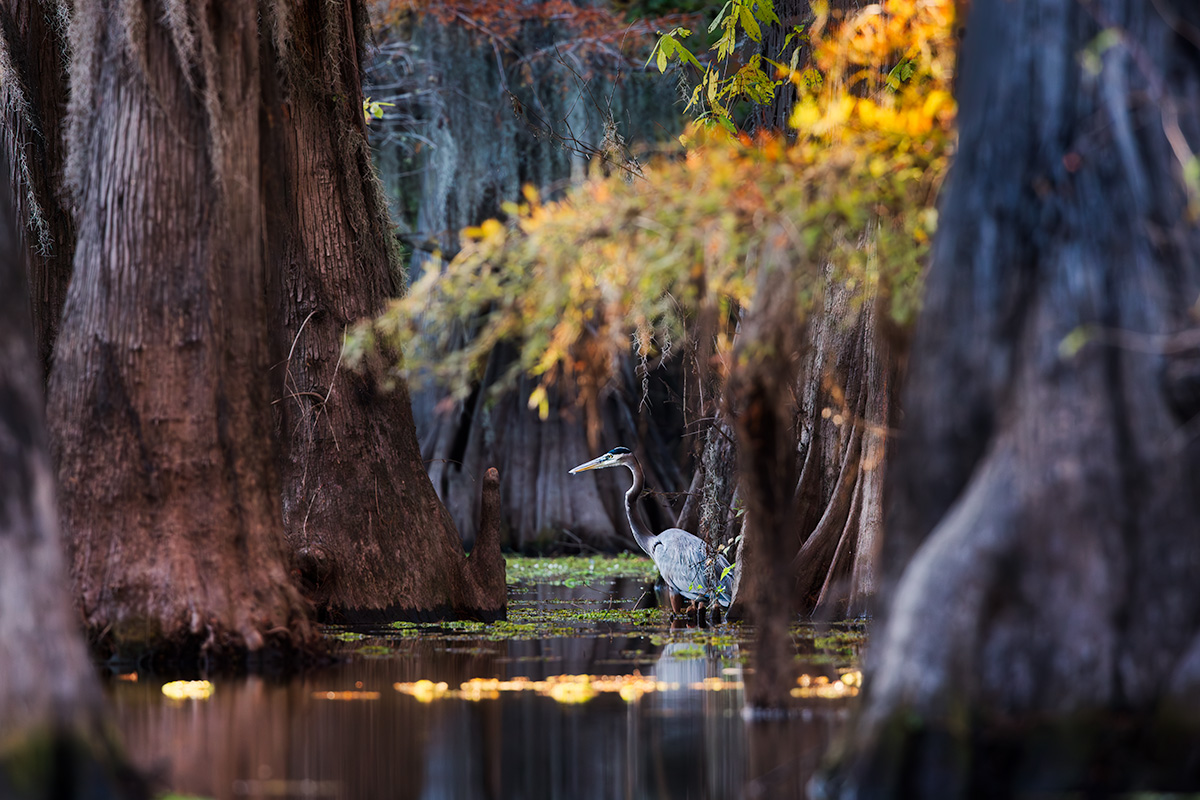
Telephoto lens. 100-500mm zoom recommended for compressing scenes, isolating details, and wildlife. A Great Blue Heron six feet from your kayak won't wait for you to change lenses.
Sturdy tripod. Carbon fiber recommended for weight savings. Must support your heaviest lens stable on uneven ground and a pontoon deck.
Filters. Circular polarizer for cutting water glare and saturating cypress color, 3-stop graduated ND for sunrise, 6-10 stop ND for long exposure work on the main lake.
Dry bag. Waterproof bag big enough for your camera body and a lens. Kayaks don't tip often, but they can.
Batteries. At least three fully charged. Cold pre-dawn mornings drain them faster than you'd expect.
Memory cards. Multiple fast cards with room to shoot RAW for four full days.
Headlamp. Red-light mode preferred. You'll use it every morning before sunrise.
Great Blue Heron in cypress swamp at Caddo Lake — wildlife photographers should bring a long telephoto lens

02

Personal Gear

Layered clothing. November mornings run 40-50°F, afternoons warm to 60-70°F. Synthetic or wool base layers, fleece mid-layer, insulated outer layer. No cotton.
Waterproof boots. Knee-high rubber boots (Muck boots or equivalent) for stepping in and out of kayaks and walking muddy banks.
Rain gear. Waterproof jacket and pants regardless of forecast. Morning dew and pontoon spray are enough to matter.
Insect repellent. DEET or Picaridin. Even in November, mosquitoes show up on warmer afternoons.
Hat, sunscreen, sunglasses. Midday sun on open water is brighter than you'd think.
Water bottle. Stay hydrated during long mornings on the water.
Snacks. Pre-dawn sessions run three-plus hours before breakfast. Bring something.

TRAVEL & LOGISTICS

Getting to Caddo Lake

Caddo Lake sits near the small town of Uncertain, Texas — closer to Shreveport and New Orleans than to Dallas. You'll need your own transportation for the photo tour — standard rental car from either airport or your own vehicle if driving in.
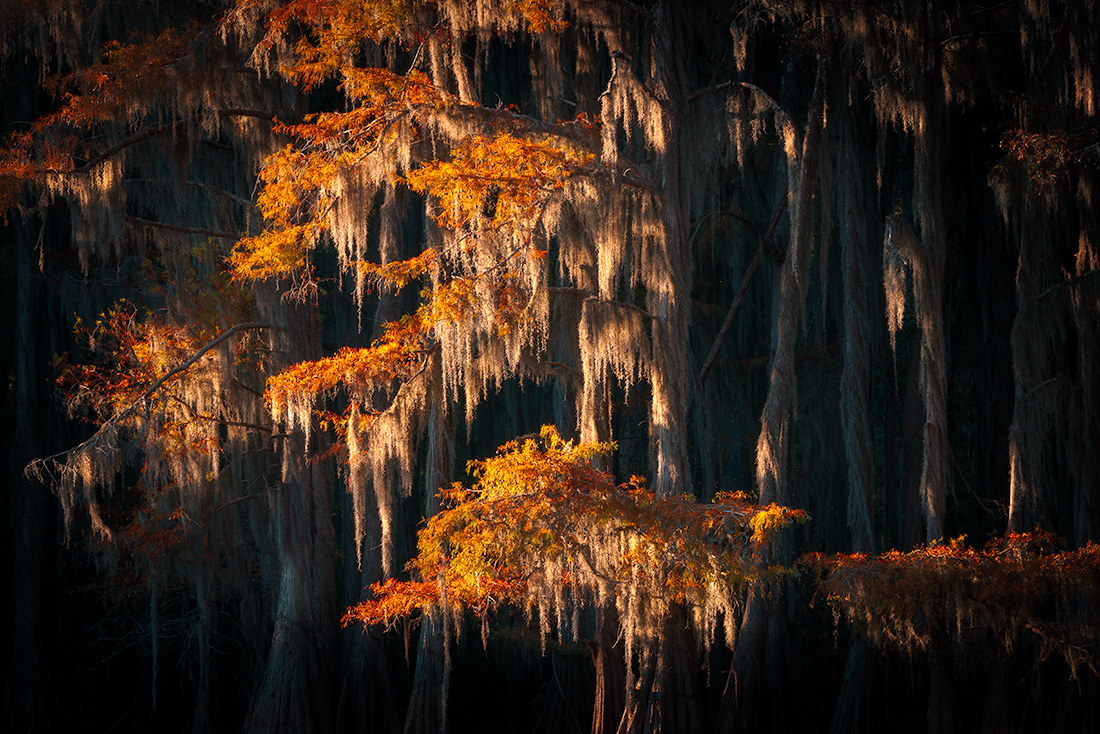
Caddo Lake cypress trees draped in Spanish moss at golden hour — the destination after travel

01

Airports

Shreveport Regional Airport (SHV). Closest option, 45-minute drive to Uncertain, Texas. Smaller regional airport with connecting flights through major hubs. Usually the faster choice if flights align.
Dallas/Fort Worth International (DFW). Major hub alternative, 2.5 to 3-hour drive to Caddo Lake. Typically more flight options and often better fares. Worth checking both.

02

Ground Transportation

Standard rental car required. You need your own transportation to the launch point each morning and back to your lodging each evening. Rideshare doesn't reliably cover Caddo Lake. If you're within reasonable driving distance, your own vehicle is the easiest option — no rental cost, and you have gear storage for the full trip.

03

Arrival Timing

The workshop starts mid-afternoon on Day 1 (around 2 PM) for orientation and first sunset shoot. Plan to arrive in the Caddo Lake area with time to settle in before then. If your flight lands in Shreveport morning-of, you can make it with time to spare. If you're flying into DFW, arrive the day before and drive in the morning of Day 1.

Workshop ends early afternoon on Day 4 after the group critique. Flights out of Shreveport after 4 PM on the final day are safe. DFW departures the same day are risky — the 3-hour drive plus airport time pushes it tight. Consider staying a night after the workshop or flying out the following morning.

LODGING

Where to Stay

Lodging is not included in the workshop price, which gives you control over where and how you stay. Caddo Lake in early November is peak fall color season for photographers — waterfront cabins and B&Bs book out months in advance, so reserve your accommodation as soon as you register for the workshop.

Closest to Launch

Uncertain, Texas

$150–400 per night

Waterfront cabins and vacation rentals. The most photogenic option. Sitting on your own dock watching morning fog roll off the water is worth the premium. Book early through VRBO, Airbnb, or local rental agencies. Expect $200–400 per night during peak season.
Bed and breakfasts in Uncertain. Smaller, charming, close to the launch. A handful of operators in town, typically $150–250 per night. Several are photographer-friendly and accommodate pre-dawn departures.
Caddo Lake State Park camping. Budget option for photographers comfortable with tent or RV camping. State park sites fill fast during November fall color. Reserve the moment your workshop spot is confirmed.

20–25 Min Drive

Marshall, Texas

$100–150 per night

Hotel chains in Marshall. Holiday Inn Express, Hampton Inn, Fairfield Inn, and similar. $100–150 per night, reliable amenities, easy booking. The 20–25 minute morning drive adds time to your pre-dawn schedule but the price tradeoff is real.
Historic Kahn Hotel in Jefferson, Texas. About 30 minutes from the launch, for those who want a more character-driven stay. Jefferson is a small historic town worth a walk during your midday breaks.

Wherever you stay, factor in the early light wake-up. Pre-dawn launches mean rolling out by 4:30–5:00 AM most mornings. The closer you stay to Caddo Lake, the more sleep you get.


Questions

Frequently Asked Questions: Caddo Lake Photography Workshop

Common questions about this small group workshop on Caddo Lake.

What skill level is required for this workshop?+

All skill levels welcome. Beginners through advanced photographers. You should know your camera settings — aperture, shutter speed, ISO, manual focus — well enough to make changes in the dark. Beginners get foundational instruction; advanced photographers get creative and technique-focused guidance.

When is the best time to photograph Caddo Lake?+

Early November for fall color and pre-dawn mist. The three workshop sessions are scheduled across the twelve-day peak color window (November 5–18) to maximize the probability of peak conditions. Best times of day: pre-dawn to 8 AM for mist and soft light; late afternoon to sunset for dramatic light and cleaner compositions on the main lake.

Do I need kayaking experience?+

No kayaking experience necessary. Caddo Lake waters are calm with no rapids or strong currents. Basic shooting-from-water technique is covered on Day 1 during the sunset orientation shoot.

What watercraft do we use during the workshop?+

Mostly kayaks, with one sunrise from a pontoon. Most shooting happens from stable wide-bottom kayaks that paddle into the backwaters and cypress sloughs where the best compositions are. One sunrise is shot from a pontoon with a local captain on the main body of Caddo Lake — larger boats give us stable tripod footing and longer exposures across open water. If you have your own kayak you'd prefer to use, bring it.

What happens if weather is bad during the workshop?+

Bad weather is usually good photography weather at Caddo Lake. Light rain, heavy mist, and overcast skies produce some of the strongest photos of the week — soft diffused light, saturated cypress color, moody compositions. We shoot through almost any condition. The workshop will only be paused for genuinely unsafe conditions like severe thunderstorms or lightning. If a session is lost to weather, we extend classroom time or add a makeup shoot when conditions allow.

Can I rent camera equipment for the workshop?+

You bring your own camera gear. If you need a specific lens or filter you don't own, contact me in advance — I may be able to help arrange a local rental or loan gear if available. A mirrorless camera or DSLR you already know well is the best tool for this photo tour.

Are meals and lodging included in the workshop fee?+

No. Both are your responsibility. This is deliberate. Keeping lodging and meals separate is why this photo tour is $2,800 instead of $4,000+ like comparable all-inclusive Caddo Lake offerings. You choose your own accommodation style and food budget. Recommended lodging and local restaurants are covered in the pre-workshop materials sent 60 days before the workshop.

How physically demanding is this workshop?+

Moderate ability required. You should be comfortable sitting in a kayak for 2–3 hours at a time, stepping in and out of boats on muddy or wet shorelines, and handling your own camera gear in and out of a dry bag. Most of the physical demand is balance and stamina rather than strenuous paddling — Caddo Lake waters are calm. If you have mobility concerns or a specific condition you're uncertain about, contact me before registering and we'll talk it through.

What is your cancellation policy?+

The $500 deposit is non-refundable. Cancellations 121 or more days before the workshop start date receive a full refund of any payments beyond the deposit. Cancellations between 90 and 120 days receive a 50% refund of payments beyond the deposit. Cancellations within 90 days of the workshop are non-refundable, as this is when final payment is due and costs are committed. Travel insurance is strongly recommended to protect your investment against unexpected cancellations, medical issues, or travel disruptions. Complete booking terms are in our Terms and Conditions.

Will I have time for independent shooting?+

Yes. Afternoons include free time for rest, independent exploration, or one-on-one instruction by request. Many participants use afternoons to revisit favorite locations from the morning shoot, process photos, or scout compositions for the next day.

Can my non-photographer partner join?+

Workshop participation is limited to registered photographers. Partners are welcome to visit the Caddo Lake area independently during the workshop. Caddo Lake State Park offers hiking trails, nature viewing, and a visitor center. Jefferson, Texas (about 30 minutes away) is a historic small town worth exploring. Marshall, Texas has additional dining and shopping. Non-photographers do not join the shooting sessions, classroom time, or the pontoon outing.

What makes Caddo Lake unique for landscape photography?+

Caddo Lake is the only natural lake in Texas and is often called the largest flooded cypress forest in the world. The ancient bald cypress trees at Caddo Lake can be over 400 years old, draped in Spanish moss and rising straight out of the tea-colored water. On calm mornings, Caddo Lake's waters create perfect mirror images of the landscape — the cypress doubled exactly until the first boat wake breaks the surface. Fog enhances depth and mood in Caddo Lake photographs, layering the trees into the distance and giving the scene the atmosphere it is known for. Early morning offers the best light for Caddo Lake photography, which is why the workshop is built around being on the water before first light.

What photography skills does the workshop focus on?+

The workshop focuses on capturing low-light conditions and challenging exposures in swamps — metering for fog, shooting before sunrise from a stable kayak, and reading reflections on calm water for symmetrical compositions. It also covers wildlife technique: wildlife is most active during the early morning hours at Caddo Lake, the same window as the best light, so a long lens stays ready alongside your wide-angle. Photographers should never disturb wildlife at Caddo Lake — no baiting, no approaching nests, no behavior that stresses the animals. Quiet, ethical fieldcraft produces the strongest frames anyway.

Still Deciding?

Let's figure out the right trip together.

Booking a workshop is a real decision, and some questions a website can't answer — your gear, your experience level, which of my trips actually fits what you want to photograph. So I set aside 45 minutes for a one-on-one call: bring your work if you'd like, and you'll leave with a clear plan and the right trip picked.

The session is $197, and if you book any workshop within a year, that full $197 comes off your deposit. If you go, it costs you nothing extra — if you don't, you've still walked away with a plan.


Final Call

Reserve Your Spot

Three sessions, five photographers each, four days in the best fall color and atmospheric window of the year. The photographers who bring home compelling images from Caddo Lake are the ones who commit to the right week and put in the dawn-to-dusk hours. Most Caddo Lake photo tours book out months in advance — don't wait on this one.
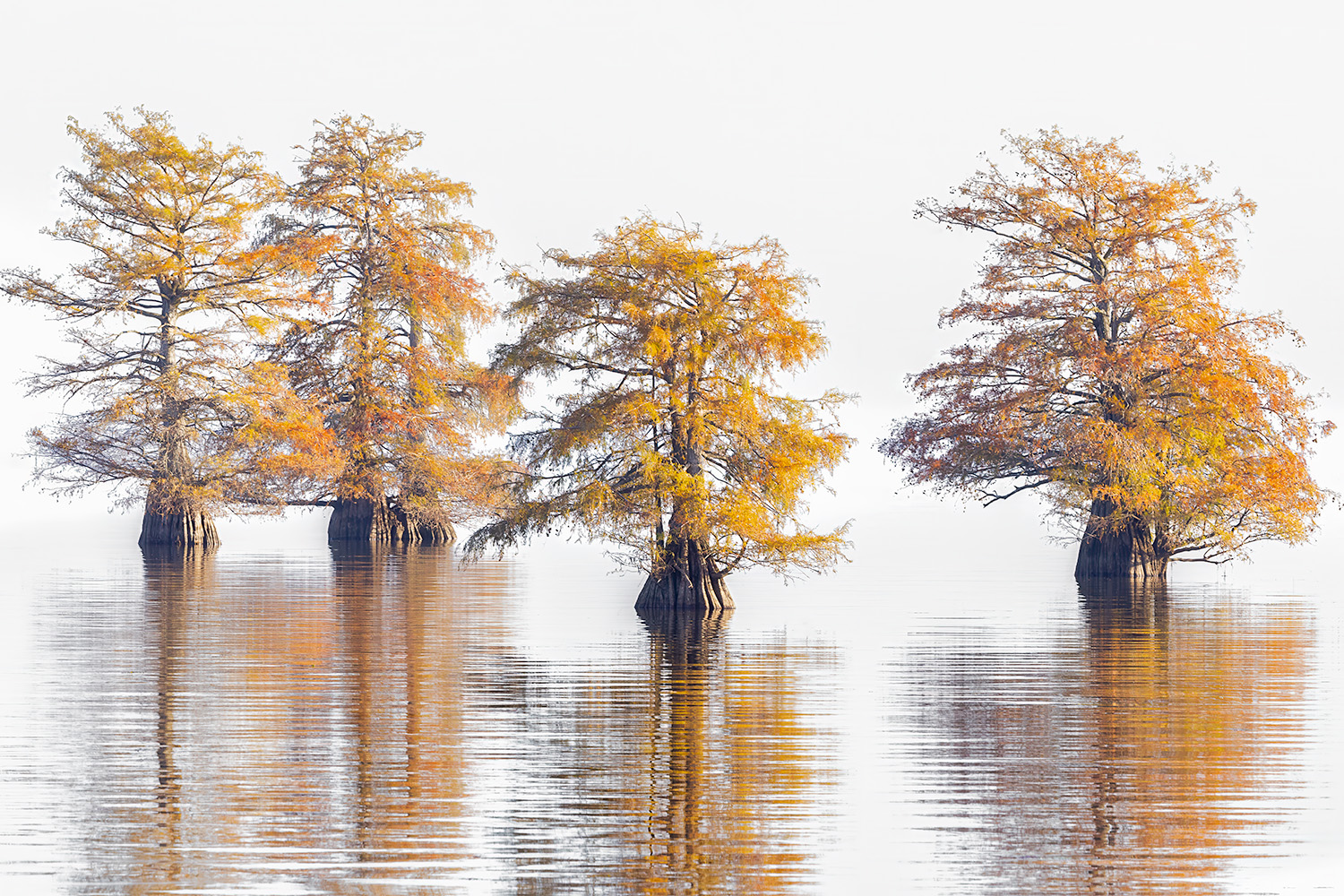
Group of cypress trees at Caddo Lake in high-key light — the photograph this workshop is built around

November 2027 Sessions

Session 1

November 6–9, 2027

Session 2

November 10–13, 2027

Session 3

November 14–17, 2027

$2,800 tuition. $500 deposit secures your spot. Final payment due 90 days before your session start date. Alumni rate available for returning FTOP workshop participants, applied at final payment.

RESERVE YOUR SPOT — $500 DEPOSIT

Limited to 5 photographers per session.

Questions before you register? I'd rather answer them now than have them hanging over your decision. Contact me — I'll get back to you within 24 hours.

Not Ready to Reserve Yet?

Take the free field guide with you

What Alaska Taught Me is my free guide to the landscape photography lessons two decades in the field have hammered home — reading light, working weather, and making images that hold up. Grab it below and I'll keep you posted as Caddo Lake sessions fill.